Midsommar: what the celebration really tells you about Sweden
When you live in Sweden for the first time, there's one date that divides the year: Midsommar. Not Christmas. Not New Year. Midsommar.
It sounds romantic, and a bit like a show for tourists: flower crowns, dancing around a decorated pole, Swedes in folk costume. And yes, all of that exists. But once you understand what's behind the celebration, you also understand why Sweden is the way it is.
What Midsommar actually is
Midsommar celebrates the summer solstice, the longest day of the year, somewhere between 20 and 26 June. In Sweden it has been a folk festival for centuries, deeply rooted in a culture that doesn't romanticise nature but takes it seriously.
For Swedes, the summer light isn't a backdrop. It's compensation. Once you've experienced the long, dark winters (and as a newcomer in Gothenburg you will), you understand why summer isn't simply enjoyed but positively celebrated.
Midsommar is the moment when Sweden collectively breathes out.
What really happens on the day
The Friday evening before the Midsommar weekend is the real heart of it. Most Swedes head out to the countryside: to the summer stuga, to friends, to family. The cities empty. Gothenburg at Midsommar can feel like a Sunday evening, only quieter.
What happens next follows a fairly fixed pattern:
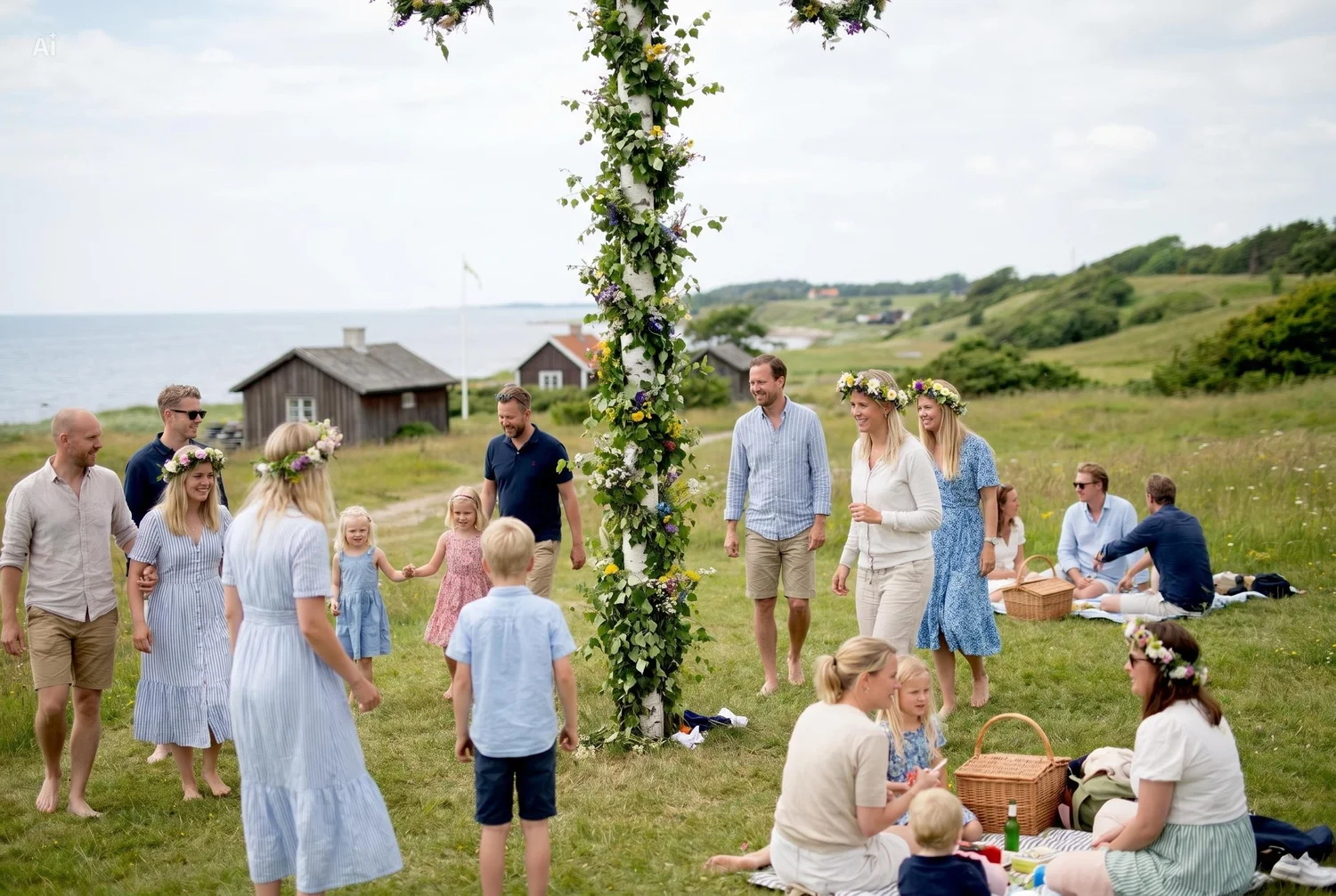
The midsommarstång, a pole decorated with birch leaves and flowers, is raised and everyone dances around it. Small children first, then everyone. There are songs that are frankly silly, and still everyone sings along, including the serious men over 50. That's not a joke. That's Midsommar.
Sill och snaps. Herring with schnapps. There are several rounds, there are drinking songs (snapsvisor), and there's a pleasant expectation that everyone joins in. If you don't like herring, there are usually strawberries. Jordgubbar are the second big Midsommar symbol: red Swedish strawberries with cream and the promise that summer has now really begun.
The light. If you experience Midsommar in Sweden for the first time, you won't be prepared for how bright it is. In Gothenburg it never gets properly dark on the night of 21 to 22 June. The sky stays deep blue, the air warm, and the mood has something unreal about it. You sit outside at midnight and it's still light enough to read. That changes your sense of time, and with it the feeling of Midsommar.
What the celebration says about Sweden
Three things strike me when I look at Midsommar through the eyes of someone who grew up in Germany:
First: the informality is real. Midsommar is one of the few celebrations where all hierarchies are briefly switched off. Boss and intern stand side by side and do the frog dance (yes, really: Små grodorna, "The little frogs", is a classic where everyone hops). It's not a performance. It's Swedish culture: the idea that in certain social moments, everyone is equal.
Second: the sense of community is palpable. In Germany, for example, people often celebrate with their family or a close circle. In Sweden, Midsommar is often bigger: neighbours, colleagues, acquaintances. The idea of coming together and experiencing something as a group carries a different weight here. For newcomers that's a gift: Midsommar is one of the easiest ways to make real connections.
Third: nature isn't optional. Spending Midsommar outdoors, in the countryside or at least in a park, is no accident. For Swedes, the connection to nature isn't a leisure activity but a basic need. Allemansrätten, the right to roam freely in nature, has its cultural roots here.
Once you've taken that on board, you also understand why Swedes never accept bad weather as an excuse. You go outside. Full stop.
Your first Midsommar: how to fit in
At your first Midsommar, you'll probably find yourself not knowing how to behave. That's normal. Here are a few things I've learned:
An invitation is worth more than you think. If someone invites you to a Midsommar celebration, it's not a casual "drop by". It's a genuine sign that you belong. Accept it.
Bring something. Strawberries, a bottle of wine, snaps, or ask beforehand what you can contribute. The preparation is often a group effort, and joining in is welcome.
Learn Små grodorna. Seriously. It's three lines and you'll need them. YouTube helps.
Stay longer than you planned. The celebration has no proper ending. It just stops at some point, when the light changes and everyone goes quiet. That's the most beautiful moment.
Midsommar as a test
If you're still wondering whether Sweden is right for you, my honest recommendation is: spend a Midsommar weekend here. Not as a tourist in the city centre, but ideally with real Swedes, outdoors, with the whole programme.
If you didn't know beforehand whether Sweden suits you, you'll know afterwards. One way or the other.
For me it wasn't a Midsommar that triggered the decision; I was already here. But it was a Midsommar in Bohuslän that made it clear to me: I'm in the right place.
About the author: I'm Sebastian Schiefner. I moved from Berlin to Gothenburg in 2022, and as a photographer and the founder of Nordabenteuer I document what moving to Sweden really means.
Questions? Write to me: hallo@nordabenteuer.de
