Tax return in Sweden 2026: what newcomers need to know
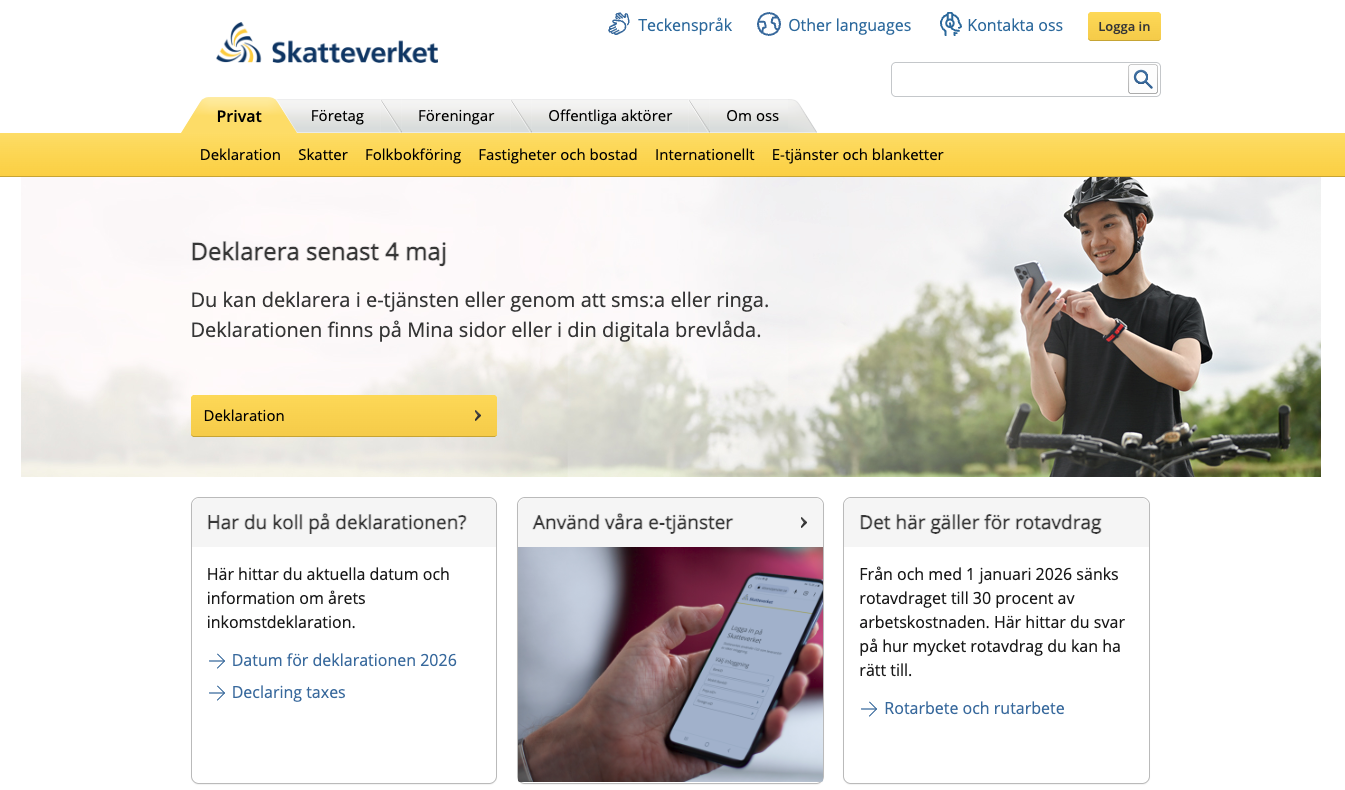
Inkomstdeklaration May 2026: what newcomers get wrong with the Swedish tax return
The deadline is approaching: on 4 May 2026 the filing period for the Swedish tax return, the inkomstdeklaration, ends. If you have moved to Sweden from abroad and don't know the system yet, you may be losing money right now, or paying tax twice without knowing it.
The good news first: for most employees in Sweden, the tax return is simpler than anywhere else in Europe. But if you have income from your home country, investments or company holdings, it gets more complicated than expected. This article explains what matters and where the real pitfalls are.
How the Swedish tax system works
Sweden has one of the most efficient tax administrations in the world. Skatteverket (the Swedish Tax Agency) already knows your income: your employer reports it automatically. In March or April you normally receive a pre-filled tax return that you only have to check and confirm.
You can do that by text message, in the Skatteverket app (with BankID) or online at skatteverket.se. If you have nothing to add, you simply enter your four-digit confirmation code. Done in five minutes.
The municipal tax rate in Gothenburg is 32.60% (as of 2026): 21.12% for the municipality plus 11.48% for the Västra Götaland region. On top of that comes state income tax of 20% on income above the brytpunkt (threshold) of 660,400 SEK a year. This is the so-called marginal tax rate, which affects very few people on normal incomes.
What's different for newcomers: the four most common pitfalls
The examples below use Germany as a worked example. If you come from another country, the principles are the same, but check whether Sweden has a double taxation agreement with your home country and what it says.
1. You still have investments in your home country
If you still hold ETFs, shares or other investments in Germany, for example, and have earned income from them, you must declare it in Sweden on the K4 form. That covers dividends, realised capital gains and interest.
It sounds simple, but it isn't always: Germany levies Abgeltungssteuer, its flat-rate withholding tax on capital income (25% + solidarity surcharge), while Sweden levies 30% capital gains tax. The double taxation agreement (DTA) between Germany and Sweden ensures that, in principle, you don't have to pay twice, but you have to actively declare it on the K4 and provide proof of the German deductions. If you forget, you will pay another 30% in Sweden on income that has already been taxed.
Practical tip: get an annual tax certificate (in Germany, the Jahressteuerbescheinigung) from your bank back home. You need it to fill in the K4 correctly and to claim the credit.
2. You were still working in your home country during the 2025 tax year
Did you only move to Sweden in 2025? Then you may be liable to tax in Germany (or your home country) for part of the year and in Sweden for the other part. A cut-off date applies: from the day you are registered in Sweden (folkbokföring), you become liable to tax here.
In practice, this means two tax returns in two countries, different bases of calculation, possible tax credits. In many cases this works smoothly, but if, for example, you had severance pay, bonus payments or capital gains in the year you moved, it is worth paying for a tax adviser with expertise in Sweden.
3. You have a company or holdings in your home country
If you are still a shareholder or managing shareholder of a GmbH (German limited company), for example, or receive profit shares from a partnership, you need to check the K10 form (for qualified shares in closely held companies) in your inkomstdeklaration. Here too the DTA applies, but the credit is not automatic.
4. You are self-employed (enskild firma) and forgot to make advance payments
If you work in Sweden as an enskild firma (sole trader), you pay tax in advance in the form of preliminärskatt (preliminary tax). If you miss or underestimate this in your first year, you can expect a back payment with interest at the final assessment in May.
What to do now, step by step
Step 1: activate BankID (if you haven't already). Without BankID you can't submit the inkomstdeklaration online. I explain how to set up BankID in a separate article.
Step 2: log in at skatteverket.se or open the app. Go to skatteverket.se/privat and log in with BankID. There you will see your pre-filled return.
Step 3: check your income. Are your salary and employer correct? Has Skatteverket recorded all deductions correctly (for example the reseavdrag, the deduction for travel to work)?
Step 4: fill in the K4 (if you have investments). Go to "Lägg till bilaga" (add appendix) → K4. Enter capital gains, losses and dividends from foreign sources. Have your annual tax certificate from your home bank ready.
Step 5: submit, no later than 4 May 2026. By app, text message or online. If you miss the deadline, you pay a late fee (förseningsavgift), which increases in stages with each reminder.
What happens after you submit?
Skatteverket calculates your final tax liability or refund. The result, skatteåterbäring (refund) or kvarskatt (back payment), usually arrives in your account in June or July, or becomes due as an invoice.
If you are expecting a refund and want to speed it up, you can register a Swedish bank account (Plusgiro or Bankgiro) with Skatteverket early on.
Do I need a tax adviser?
For most employees without investment income or cross-border complications: no. The system really is simple.
For everyone else (self-employed, with investments back home, with company holdings or in the year of the move), my honest recommendation is: yes, or at least one consultation. The cost of a mistake (back payment + interest + a possible penalty for incorrect information) usually far exceeds the cost of advice.
Conclusion
For employees without cross-border complications, the Swedish tax return is a five-minute job. For newcomers dealing with investments, company holdings back home or a move during 2025, it becomes a real task, and with the deadline on 4 May, there's no time left to put it off.
If you are unsure what applies in your case: I'm happy to advise you in a free intro call and tell you honestly whether you can manage it yourself or need a professional.
→ Book a free intro call
Note: this article is for general information and is not a substitute for tax advice. Individual tax cases, especially those involving more than one country, should be discussed with a qualified tax adviser.
