Taxes in Sweden: the real numbers
Category: Costs · Reading time: approx. 7 minutes
"Sweden has high taxes." That's true. But what that actually means, how the system works and where it pleasantly surprises you is something hardly anyone explains properly to newcomers. This article gives you real numbers and clears up the most common misunderstandings.
How high is income tax really?
In Sweden, income tax is levied at two levels:
Municipal tax (kommunalskatt): around 30 to 35 per cent, depending on the municipality. In Gothenburg in 2026, it's exactly 21.12 per cent to the municipality plus 11.48 per cent to Västra Götalandsregionen, 32.60 per cent in total (Skatteverket, Kommunala skattesatser 2026). That's 0.7 percentage points below the national average. Everyone pays this tax, regardless of income.
State tax (statlig skatt): an additional 20 per cent, but only on the part of your taxable earned income above the skiktgräns (the threshold). In 2026 it's 643,000 SEK. Calculated on gross salary, this means the brytpunkt (break point) is 660,400 SEK a year, so around 55,000 SEK a month (Skatteverket, Skiktgränser 2020–2026). If you earn below that, you pay no state tax at all.
What you end up with net can't honestly be put into a table that's right for everyone: the grundavdrag (basic allowance) and jobbskatteavdrag (earned income tax credit) depend on your income, church-related fees (the begravningsavgift, or burial fee, and possibly the kyrkoavgift, or church fee) are added depending on membership, and the tax rate changes with the municipality. Skatteverket will work it out for your specific case: the calculator "Räkna ut din skatt" (work out your tax) on skatteverket.se needs your gross salary, year of birth and municipality of residence and gives you the net amount to the krona. As a rough guide for Gothenburg: on average white-collar salaries, the actual tax burden ends up noticeably below the nominal 32.60 per cent, because the jobbskatteavdrag offsets it.
The jobbskatteavdrag: the pleasant surprise
What most newcomers don't know: Sweden has the jobbskatteavdrag, a tax credit specifically for people in work. It automatically reduces the tax you actually pay, depending on how much you earn.
The result: for middle incomes, the effective tax rate is often lower than it seems at first glance. An employee earning 40,000 SEK gross in practice pays less than the nominal 32.60 per cent municipal tax would suggest.
Employer contributions: the invisible burden
What many people don't know: on top of your gross salary, your employer pays approx. 31.42% in employer contributions (arbetsgivaravgifter) to the state. This covers pension, sick pay, parental leave and other social benefits.
That means: if you earn 40,000 SEK gross, you actually cost your employer around 52,600 SEK a month. You never see this number, but it matters if you're self-employed or want to understand the total cost in salary negotiations.
SINK: the special rule often mistaken for a newcomers' rule
Something often gets mixed up here. SINK (särskild inkomstskatt för utomlands bosatta, special income tax for people resident abroad) is not a rule for newcomers, but the opposite: it applies to people who earn income in Sweden but do not live here and are not folkbokförd (registered in the population register), in other words who remain begränsat skattskyldig (with limited tax liability). The tax rate is a flat 25 per cent, without deductions and without the jobbskatteavdrag, and it has to be applied for with Skatteverket.
In practice, SINK is relevant for commuters, for temporary assignments without a move, and for pensioners abroad with Swedish pension entitlements. As soon as you move to Sweden and register, you become obegränsat skattskyldig (with unlimited tax liability), and then normal taxation applies, not SINK.
Double taxation agreements: the Germany–Sweden example
Whether and how you could end up taxed twice depends on your home country, so check whether it has a double taxation agreement with Sweden. Let's use Germany as the worked example. Germany and Sweden have a double taxation agreement (in German: Doppelbesteuerungsabkommen, DBA): as a rule, you only pay income tax in the country where you are tax resident.
In practice, for someone moving from Germany, this means: as soon as you're registered in Sweden and working there, you usually only pay Swedish income tax. In Germany a registration obligation remains, but no tax liability on Swedish income, provided you have deregistered correctly.
Important: if you also have income in Germany at the same time (e.g. rental income, fees) or haven't deregistered yet, you have to take both systems into account. A short consultation is worthwhile here, ideally with a tax adviser who knows both systems. The same applies whichever country you come from: if you still have income at home, get advice from someone who knows both sides.
Capital gains tax
Gains from selling shares, ETFs or other investments are taxed at 30 per cent in Sweden, with no tax-free allowance of the kind some countries have. In Germany, for example, that's the Sparer-Pauschbetrag (€1,000 per person, €2,000 for couples filing jointly). A separate, lower rate applies to property sales.
The exception: the ISK account (investeringssparkonto, investment savings account), a Swedish savings model in which you pay a flat-rate tax on the value of the account instead of on realised gains. Since 2026, an account value of up to 300,000 SEK has been exempt from the flat-rate tax (in 2025 it was 150,000 SEK). For most small savers, this means: effectively tax-free. That's why many Swedes use the ISK as their standard form of investment.
The Swedish tax return (deklaration)
Here's the best news: the Swedish tax return is considerably simpler than in many other countries, and certainly than the German one.
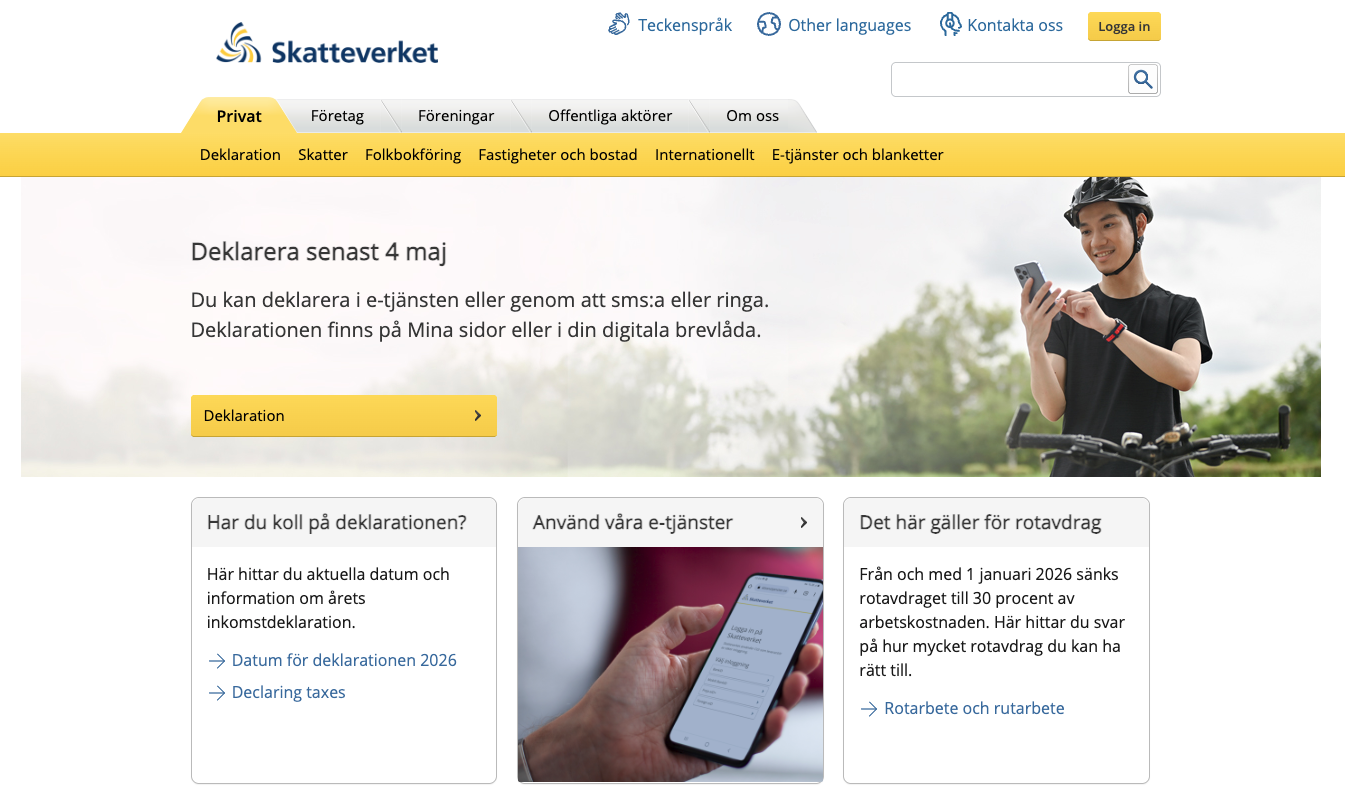
In spring, Skatteverket sends you a pre-filled tax return. Often you only have to enter three digits by text message to confirm it, and you're done. If you have no side income, no property and no complicated situation, you're through in a few minutes.
What's really different
Pleasant surprises:
- Tax return in 5 minutes instead of 5 hours
- The jobbskatteavdrag noticeably lowers your effective tax rate
- Childcare (förskola) is heavily subsidised by the state, which often saves families more than the higher tax costs them
- Sick pay is paid from the first day of illness; a karensavdrag (waiting-period deduction) of 20 per cent of an average week's sick pay is deducted (since 2019, this has replaced the former full karensdag, the unpaid first day)
Unpleasant surprises:
- No tax-free benefits in kind like those in Germany, for example (company cars and public transport passes are treated quite differently)
- No tax-free savings allowance on investment income
- Employer contributions make self-employment more expensive than expected
Conclusion
Swedish taxes are higher than, for example, German ones, but not by as much as many people think. If you're employed full-time, you'll notice the difference, but you also get something in return: parental leave, health cover, förskola, a pension. How it balances out is personal. If you have specific questions about your own tax situation, look for a tax adviser with experience of Sweden, or ask me and I can point you in the right direction.
As of September 2026. Tax rates and thresholds change every year; Skatteverket publishes the current figures under "Belopp och procent" (amounts and percentages).
Read next: The Swedish west coast: seals, porpoises and the archipelago
Sweden: the regions at a glance, the in-depth guide on this topic (currently available in German): view it in the shop.
I'm Sebastian Schiefner, a photographer in Gothenburg, and I help people who are moving to West Sweden with finding a home and buying property. Free intro call.
