Winter tyres in Sweden: the rules, studs and the däckhotell
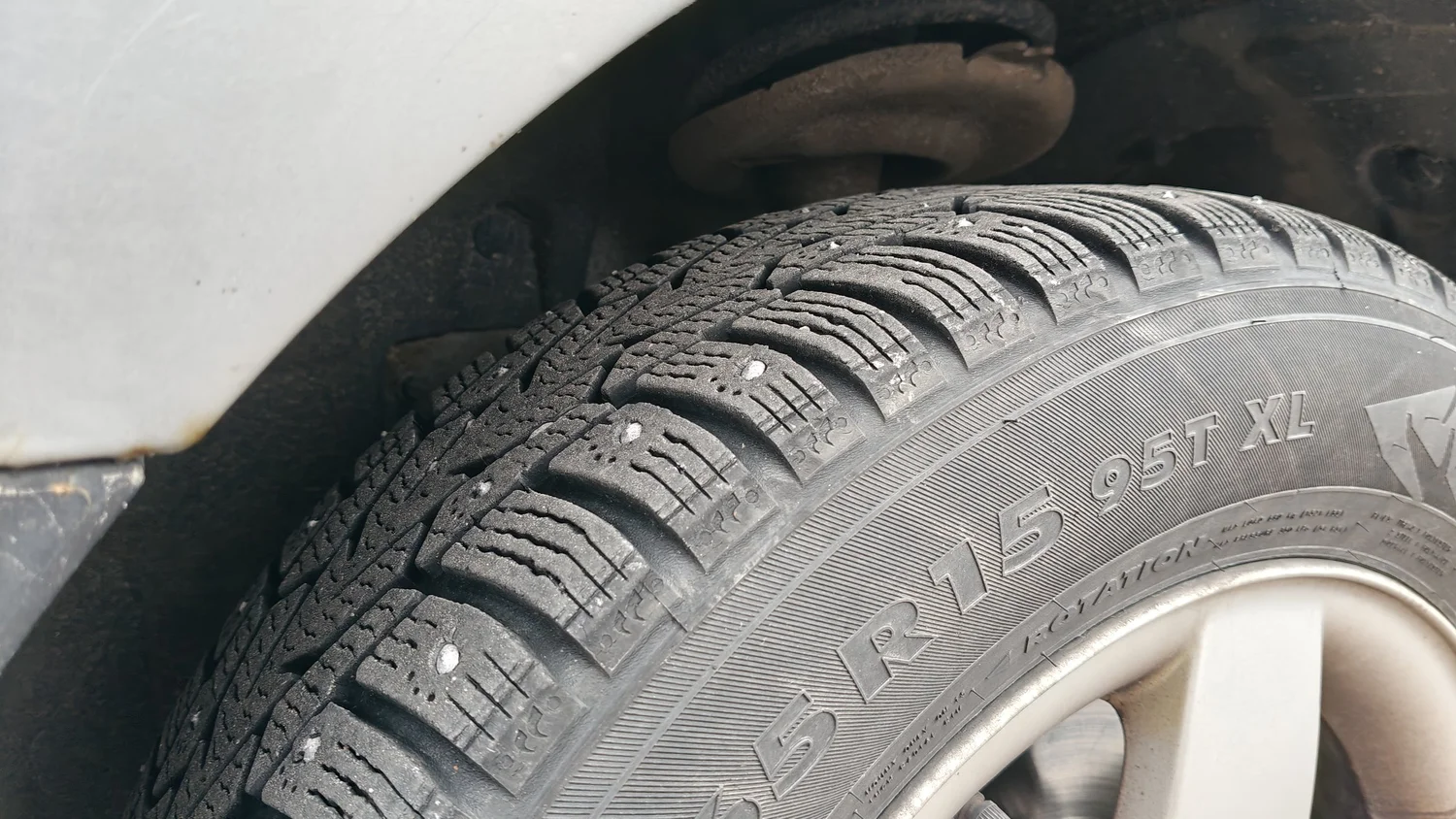
At some point in October, banners saying "Boka däckbyte" (book your tyre change) go up outside the garages, and neighbours start asking each other whether they've changed yet. If you've driven in Germany, for example, you'll think of the "O to O" rule of thumb (October to Easter) and a winter tyre requirement that depends on the conditions. Sweden works in a similar way, but not identically. There's a fixed period, a stricter minimum tread depth, a separate rule for studded tyres, and in Gothenburg two streets where studs are banned.
On top of that there's a word you'll hear on your first visit to a garage, if not before: däckhotell, literally "tyre hotel". As a property photographer I'm out and about by car around Gothenburg all year. This article sums up what the authorities actually require and what you need to organise in practice.
When winter tyres are compulsory in Sweden
The rule is in the Trafikförordningen (the Road Traffic Ordinance), chapter 4, § 18 a. Roughly translated, it says: cars, light lorries and their trailers must be fitted with winter tyres or equivalent equipment when driven on the road from 1 December to 31 March if winter road conditions prevail. In the original: "när vinterväglag råder".
Those are two conditions that have to apply together:
- The period: 1 December to 31 March.
- Vinterväglag (winter road conditions): according to Polisen (the Swedish Police), winter road conditions apply "om det är snö, is, snömodd eller frost på någon del av vägbanan eller vägrenen". In other words, snow, ice, slush or frost on any part of the carriageway or the hard shoulder.
Who decides whether that's the case at a particular spot? Transportstyrelsen (the Swedish Transport Agency) is clear about it: the police judge whether winter road conditions prevail at the place where you happen to be.
In practice that means: frost on the hard shoulder is enough. In my experience, winter on the west coast is often wet rather than snowy, but there's still frost on bridges and in dips in the road. So it's worth changing your tyres when the nights turn cold, rather than waiting for 1 December.
Which tyres count as winter tyres
Something changed here just under two years ago that's easy to miss. Since 1 December 2024, according to Transportstyrelsen, non-studded winter tyres for cars must carry the "alptopp/snöflinga" symbol, the three-peaked mountain with a snowflake. Internationally it's called 3PMSF, and in English it's often referred to as the alpine symbol. A tyre marked only M+S therefore no longer meets the requirement for a non-studded winter tyre.
The second number you need to know: 3 millimetres minimum tread depth during the winter tyre period. That's what Transportstyrelsen and Polisen say. In Germany, for example, the legal limit according to the ADAC (the German automobile club) is 1.6 millimetres, even for winter tyres. So a set of tyres that's still legal elsewhere may already have too little tread in Sweden.
In addition, according to Transportstyrelsen, all tyres on a vehicle must be of the same type. Two studded tyres at the back and two non-studded ones at the front won't do.
| Sweden | Germany (for comparison) | |
|---|---|---|
| Requirement | 1 Dec to 31 March, when vinterväglag prevails | depends on conditions, when roads are wintry |
| Marking for non-studded winter tyres | Alpine symbol (3PMSF) | Alpine symbol, M+S alone no longer enough |
| Minimum tread for winter tyres | 3 mm | 1.6 mm (ADAC recommends 4 mm) |
Foreign number plates and fines
The rules also apply to your car if it still has foreign plates. Polisen puts it clearly: the winter tyre rules also cover foreign vehicles and apply when travelling to and from abroad. So the winter tyres you bring with you must have the alpine symbol and at least 3 millimetres of tread. Check this before you set off, not once you're already past Kungsbacka.
If you drive without winter tyres between 1 December and 31 March in winter road conditions, the fixed fine according to Åklagarmyndigheten's (the Swedish Prosecution Authority's) list of fines is 2,000 kronor. The amount was raised from 1,200 to 2,000 kronor in February 2025. Some websites still quote older amounts; the authoritative source is Åklagarmyndigheten's list.
When a car registered abroad has to be re-registered in Sweden is a separate topic. What it means for parking in the city is covered in my article on resident parking in Gothenburg. You'll find an overview of all the official steps after your move in my roadmap to the Swedish authorities.
Studded tyres: allowed, but not everywhere
In Sweden, studded tyres, dubbdäck in Swedish, are allowed on cars, but only within a fixed time window. According to Polisen you may use them from 1 October to 15 April. From 16 April to 30 September they're banned. The exception: if winter road conditions prevail or are expected, Transportstyrelsen says you may also drive with studs outside this period.
If your car has studded tyres and you're towing a trailer, Transportstyrelsen says the trailer's tyres must be studded too.
Gothenburg has a local ban on studded tyres. According to Göteborgs Stad (the City of Gothenburg), you may not drive with studded tyres on Friggagatan and Odinsgatan. The city's reason is air quality: it says the ban reduces the harmful particles that studs tear out of the asphalt by 15 to 20 per cent. Crossing traffic is exempt: with studs you may cross Odinsgatan at Barnhusgatan and drive through the roundabout at Odinsplatsen. Emergency services, police, ambulances and other essential transport are also exempt. If you're caught with studs anyway, the city says you'll pay 1,000 kronor.
As of today, the city lists the ban on its website. If you live or work around Odinsplatsen, that's an argument for non-studded winter tyres. Otherwise the choice depends on where you drive. That's not a legal question but a question of your usual routes, and the best place to talk it through is at the garage.
Däckhotell: what it is and how it works
A däckhotell is simply tyre storage at the garage, a service you may already know from home. The principle:
- You take your car in for the tyre change.
- The garage fits the seasonal tyres and takes the other set into storage.
- The stored tyres are cleaned and checked.
- Before the next season, the big chains remind you by text message, you book an appointment, and it all happens in reverse.
Exactly what's included varies by provider. Euromaster says: "I däckhotellet ingår däckbyte, förvaring samt en grovtvätt av hjulen", meaning tyre change, storage and a rough wash of the wheels. There, you pay for the coming season when your tyres are changed. Vianor also lists, for Gothenburg, a digital tread depth report by email and insurance for the stored tyres. At Bilia, according to its own website, a check of tyre pressure, tread depth and rims is included, plus a text message with photos.
The tread measurement in particular is useful for newcomers. You find out in good time whether the winter tyres you brought with you still meet the 3-millimetre limit, rather than only when you get them out of the cellar in November.
What a däckhotell costs, and when to store tyres yourself
The big chains usually only publish "from" prices, depending on tyre size, vehicle and package. Two examples, checked on 28 September 2026:
- Vianor: "Från 970 kr" (from 970 SEK) for a tyre change and storage for one season.
- Bilia: "Från 1.695 kr/säsong" (from 1,695 SEK per season) in price group 1 and "Från 1.995 kr/säsong" (from 1,995 SEK per season) in price group 2, each including the tyre change. There, the price group depends on make and model.
Euromaster doesn't give an amount on its website and refers you to the garage, because the price depends on tyre size.
Important when comparing: ask exactly what "säsong" (season) means, i.e. whether you pay once per change or once a year, and whether balancing, hand washing or insurance cost extra. You'll find an overview of running costs in my article on the cost of living in Sweden.
Whether it's worth it depends mainly on how you live. With a garage or a shed, you store the tyres yourself and only pay for the change. In a city flat, it's a different story. In the older buildings in Linnéstaden, Vasastan or Majorna, a flat often comes with a förråd, a storage cage in the cellar; I see that regularly at viewings. But carrying four complete wheels down the cellar stairs and back up again isn't everyone's idea of fun. Also ask beforehand whether your bostadsrättsförening (housing association) or landlord allows tyres to be stored in the förråd. That's set out in the house rules, and they vary from building to building. If you're still looking, ask specifically about storage and parking at the viewing; more on that in my article on finding a flat in Gothenburg.
Your checklist for October and November
- Measure the tread: at least 3 millimetres on winter tyres. A simple tread depth gauge from a DIY store is all you need.
- Check the symbol: non-studded winter tyres need the alpine symbol. M+S alone isn't enough.
- Book early: in my experience, appointments get scarce as soon as the first cold nights arrive. If you book in October, you'll have more choice.
- Studs or not: on no earlier than 1 October, off by 15 April, unless there's winter weather. In Gothenburg, avoid Friggagatan and Odinsgatan.
- Car with foreign plates: the rules apply in exactly the same way. Check the tyres you're bringing before you set off.
- Compare däckhotell offers: don't just look at the "from" price; ask what's included.
If you're planning your move to Gothenburg right now and aren't sure in which order to tackle the car, the flat and the authorities, you can ask me directly through my consulting page.
