Boating licences in Sweden: förarintyg and kustskepparintyg
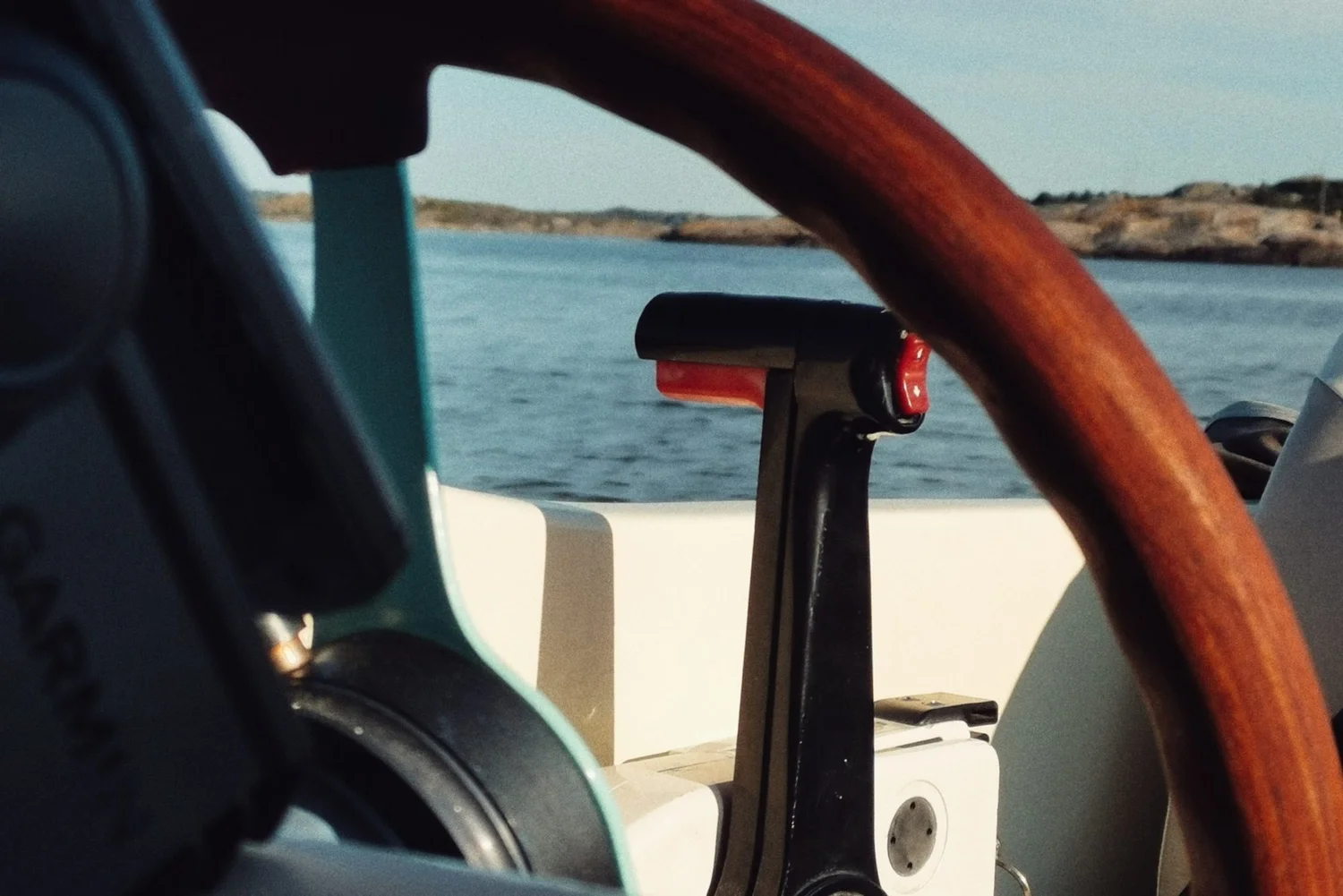
In May, the west coast shakes off the winter. The marinas in Långedrag, Hovås and Marstrand fill up, the first charter boats in Bohuslän go into the water, and the "sign up for a förarintyg course now" ads reappear in the Swedish classifieds. If you want to sail, take a motorboat out or hire a touring kayak in the skerries, you'll quickly run into a question nobody answers clearly in English: do I even need a boating licence in Sweden? And does the licence from my home country count here?
The short answer is surprising: officially, very little is mandatory in Sweden. In practice, it's a different story.
The legal position: Sweden has almost no licence requirement
By international standards, Sweden is relaxed. There is no boating licence required by law for most leisure boats. Put simply: if you want to skipper a motorboat up to 12 metres long and 4 metres wide, or a sailing boat below these limits, the law doesn't require you to hold any document.
That threshold is considerably higher than in some other countries. In Germany, for example, the Sportbootführerschein See (the German coastal motorboat licence) is required from 15 hp. A Buster XXL with 200 hp can be driven in Sweden without a licence. In Germany, the same boat owner would need the Sportbootführerschein See plus possibly a radio operator's certificate to legally leave the harbour.
Where requirements do apply:
The förarbevis höghastighetsbåt (high-speed craft certificate) is mandatory for boats that go faster than 35 knots or are more than 15 metres long.
The skepparexamen is mandatory for commercial skippers.
A kustskepparintyg equivalent is formally only required in a few commercial situations.
So for the average newcomer who wants to hire a charter boat in Marstrand for a summer weekend, the law isn't an obstacle.
Why almost everyone should still get a förarintyg
This is where reality comes in: rental companies and insurers ask.
If you want to hire a charter boat in Bohuslän from Nautic Center in Marstrand, from Långedrag Marina or from one of the many smaller providers in Smögen or Fjällbacka, you'll routinely be asked for a boating licence. Some accept a German Sportbootführerschein See without a murmur. Many prefer the Swedish förarintyg, because they know the document and can judge what it covers. Some, especially the larger providers with their own insurance in the background, explicitly insist on it.
For your own boat, the insurance question is even sharper. Swedish boat insurers such as Svedea or Atlantica require the förarintyg as proof of your qualification as a skipper for boats from 30 hp or above a certain insured value (typically 500,000 SEK). Without that proof, the excess in the event of a claim is drastically higher, or the insurer refuses to pay at all.
So what is formally "voluntary" is, in practice, effectively mandatory for anyone who wants to move more than an inflatable dinghy with an outboard.
Förarintyg: what it is and what it costs
The förarintyg is the basic Swedish certificate for skippers in coastal waters. It covers the basics of navigation, the collision regulations (KVR), lights, sea marks, weather, safety equipment and what to do in an emergency. Unlike the German Sportbootführerschein, for example, it isn't issued by the state but by the Nämnden för Båtlivsutbildning (NFB), a foundation that has coordinated Swedish boating education since the 1960s.
The course typically runs like this:
Format: 8–12 evenings over four to six weeks, or one intensive weekend
Providers in Gothenburg: Studieförbundet Vuxenskolan, Medborgarskolan, NavigationsCenter Göteborg, several private skipper schools
Language: Swedish (English courses exist but are rare; with some preparation, a Swedish course is manageable for a beginner from abroad)
Cost: 2,500–4,500 SEK including course materials and exam fee
Exam: a written multiple-choice exam, around 40 questions, pass mark 75%
What the förarintyg does not cover: practical boat handling. There's no practical exam. If you've never handled a boat, you should book a separate practical course; many marinas offer one-day training for 1,500–2,500 SEK.
Kustskepparintyg: for open water and longer trips
The kustskepparintyg (coastal skipper certificate) builds on the förarintyg and qualifies you for trips in open coastal waters and longer distances, for example from Bohuslän across the Kattegat to Denmark, or through the Sound to Stockholm.
The content goes deeper:
Tide and current calculations (of limited relevance in Sweden, important in Danish waters)
Radio communication (can be combined with the VHF certificate, which is at SRC level)
Advanced navigation with charts, compass and electronic aids
Interpreting weather and storm warnings
Emergency and safety management on longer trips
The exam is structured similarly but is more demanding. Costs are typically 3,500–6,000 SEK, often booked as a follow-on course to the förarintyg.
For most newcomers in Gothenburg who spend their summers in the skerries between Vrångö and Marstrand, the förarintyg is enough. You only need the kustskepparintyg once you're seriously planning longer distances, such as west coast trips up to Strömstad or crossings to Læsø.
Using a licence from home: the German example
How well a licence from your home country works here varies. Let's use the German Sportbootführerschein See (SBF See) as the worked example: it is formally recognised in Sweden, but not treated the same way everywhere.
What works:
Harbourmasters and authorities only ask for it in the rare mandatory cases (commercial use, high speed), and there they accept the German licence as equivalent without any problem.
Some boat rental companies in the larger marinas accept it without discussion, especially those with an international clientele.
Some insurers take it into account if you actively present it before signing and have it included in the policy application.
What doesn't work:
Many smaller boat rental companies in Bohuslän don't know the German document and push for the förarintyg because they can't assess anything else. Arguing on the jetty rarely helps.
The International Certificate of Competence (ICC) is a better companion for Sweden than the SBF See on its own, provided you applied for it before moving, through the DSV or DMYV (the German sailing and motor yacht associations).
If your licence is from another country, check with the issuing body at home whether it can also issue an ICC.
Practical tip: if you're moving from Germany with the SBF See and your first Swedish summer is coming up, apply for the International Certificate of Competence (ICC) afterwards. At the DMYV it costs under €50 and is recognised far more routinely in Sweden than the national licence. If you're staying longer, the most relaxed option is to get the förarintyg as well (alongside your home licence).
The NFB exam in Gothenburg: dates, registration, logistics
Exam dates for the förarintyg and kustskepparintyg are run through the individual course providers, not centrally through NFB. In Gothenburg there are exam dates practically every week between February and June, and the rush starts in April, when it becomes clear the season is coming.
You register directly with the course provider:
Studieförbundet Vuxenskolan Göteborg: several förarintyg courses per season, located in the city centre, good for people who work (evening courses)
Medborgarskolan Väst: intensive weekend courses, more for newcomers to boating who are short on time
NavigationsCenter: a specialist provider, can be combined with the VHF radio certificate and practical boat training
Private skipper schools: for example Bohusläns Sjöskola in Stenungsund, often with their own training boat for practical modules
If you're not yet confident in Swedish, check beforehand whether the course can be run in English. Some providers do this for mixed groups, others insist on Swedish, which is also relevant for the exam itself, because it only exists in Swedish.
What the förarintyg gets you in practice, and what it doesn't
What you can do once you've passed:
Hire charter boats from most providers in Bohuslän and on the west coast, without any discussion
Take out Swedish boat insurance on standard terms
Be taken seriously as a skipper by marinas and harbourmasters, which opens doors when the weather turns or when skippers help each other out
Clearly document, if there's a claim, that you were qualified to skipper that type of boat, which is decisive for how the insurance claim is handled
What you can't do:
Drive high-speed boats over 35 knots: for that you need the förarbevis höghastighetsbåt
Operate commercially or carry passengers for payment: for that you need the skepparexamen
Automatically operate radio equipment: the VHF certificate (SRC) is separate
The seasonal logic: why May is the right moment
If you want to do the förarintyg in summer, you'll usually be too late: in Gothenburg, the high-season courses from mid-June to August are mostly fully booked, and the few free places are offered at higher prices. The Swedish seasonal rhythm is clear:
February–March: sign up for spring courses, order course materials
April–May: course phase, exam dates in May
June–August: boat in the water, gain experience
September–October: last remaining places for late starters, often cheaper
If you don't have a licence yet in May 2026 but want to hire in July, you have two realistic options: an intensive weekend course in May or early June, or bring your ICC (if you have one) as a stopgap and hope the rental company is understanding.
Practical advice for your first summers in the skerries
If you're new to Gothenburg and plan to charter regularly or buy your own boat, tackle the förarintyg in your first spring, not later. The investment of around 3,000 SEK and 30 hours of teaching pays for itself several times over in your first two seasons, just through lower insurance premiums and no longer risking being turned away at the charter desk.
For anything beyond a relaxed weekend trip, such as tours up to Smögen, Tjörn–Marstrand–Vinga routes or crossings to Læsø, the follow-on course for the kustskepparintyg is worth it in your second year.
And if you just want to hire a small motorboat in Långedrag with the family once in summer to see the skerries: for that, a German SBF See plus a friendly chat is usually enough. But that's the exception, not the rule.
Buying a house in Sweden: practical guide, the in-depth guide on this topic (currently available in German): view it in the shop.
I'm Sebastian Schiefner, a photographer in Gothenburg, and I help people who are moving to West Sweden with finding a home and buying property. Free intro call.
