ROT and RUT: Sweden's tax deduction for tradespeople and household services
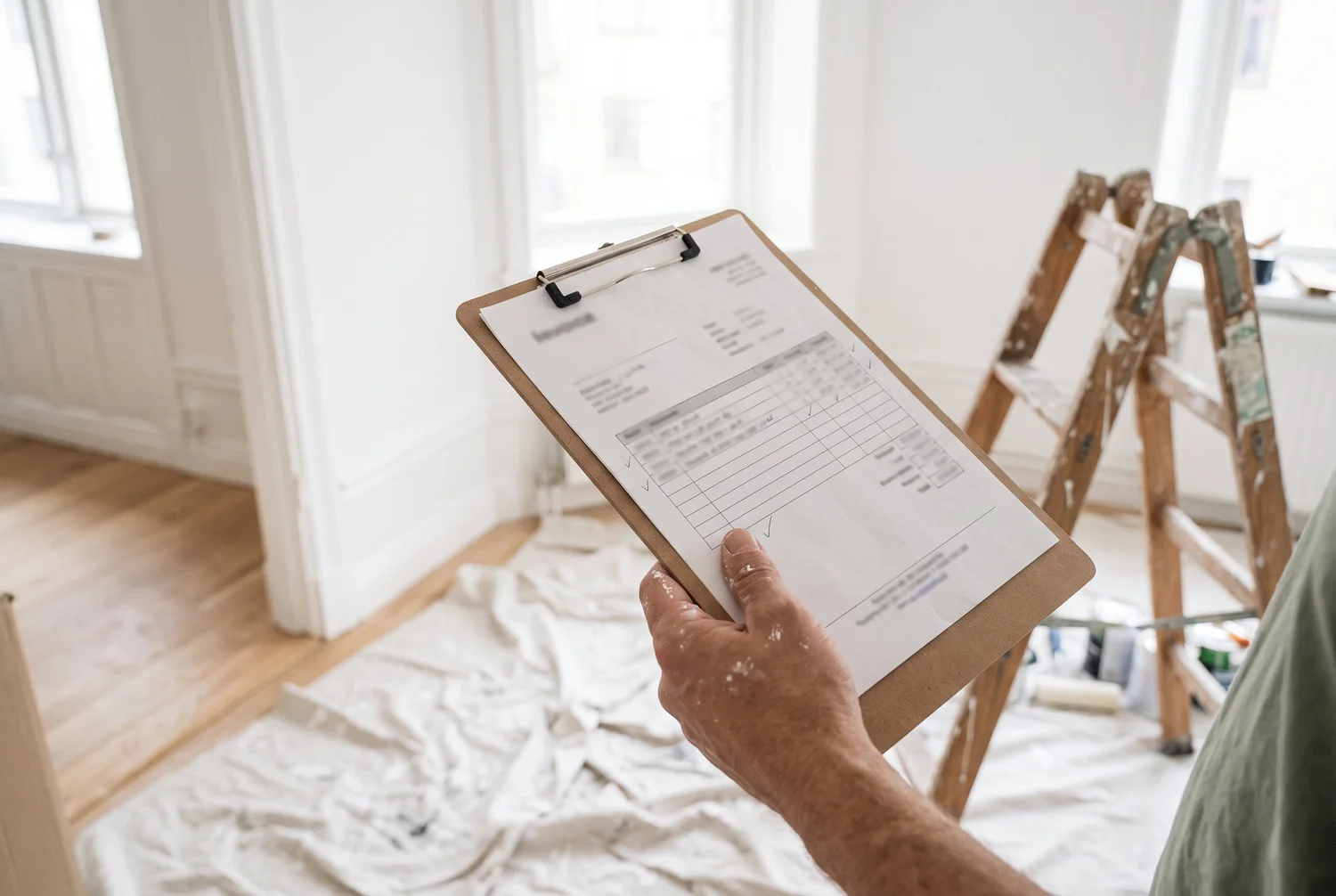
The first time you hire a tradesperson in Sweden (to sand a floor, renovate a bathroom, fit a kitchen) and the quote is in front of you, something happens two lines further down that newcomers regularly overlook: an item called "ROT-avdrag" deducts a third of the labour cost before you have even signed. You don't pay the full amount. You pay the difference. The tradesperson claims the rest directly from Skatteverket, the Swedish Tax Agency.
This is not a special offer. This is the system.
ROT-avdrag and its sibling RUT-avdrag are two of the most effective and widely used tax deductions in Sweden. Whether you buy a house or a bostadsrätt here, move into a rented flat or simply organise your move, sooner or later you will come across both. But if you don't understand the system, you overpay by five-figure sums every year, usually because you don't even know you're entitled to it.
What ROT and RUT deductions actually are
Both abbreviations are Swedish acronyms.
ROT stands for Reparation, Ombyggnad, Tillbyggnad: repair, conversion and extension. The tax deduction applies to labour costs for building, renovation and modernisation work on your own flat or your own house. So if you replace floors, move walls, tile a bathroom or install a new kitchen, the labour part of the invoice can be subsidised.
RUT stands for Rengöring, Underhåll, Tvätt: cleaning, upkeep, laundry. This deduction applies to household services: cleaning help, window cleaning, garden maintenance, removals, childcare outside the förskola (preschool), snow clearing, caretaking tasks.
The crucial point is the mechanism. You don't pay in full, wait for a tax return and get money back later. Instead, the tradesperson or service provider deducts the amount directly from the invoice and reports it to Skatteverket. You only ever see the reduced amount. The procedure is called "fakturamodellen", the invoice model, and it is exactly what makes uptake so high: no paying up front, no application, no bureaucratic hurdle.
The key figures as of 2026
The conditions have changed several times over the years. What applies in 2026 is essentially the following (political changes are always possible; you will always find the current rates at skatteverket.se):
ROT deduction:
- Refund: 30% of labour costs. The temporary increase to 50% has expired; in 2026 the rate is back at 30% (Skatteverket).
- Maximum: 50,000 SEK per person per year, and at the same time the upper limit within the shared cap (see below).
- Married couples and sambo partners (cohabiting partners) with joint ownership: each has their own maximum, so together up to 100,000 SEK of ROT (2 × 50,000 SEK).
RUT deduction:
- Refund: 50% of labour costs.
- Maximum: 75,000 SEK per person per year, but that is the cap for ROT and RUT combined, not for RUT alone.
- Here, too: per person, not per household.
Combining them, the point where most people miscalculate: Skatteverket adds ROT and RUT together. Combined, the maximum is 75,000 SEK per person per year, of which no more than 50,000 SEK may be ROT. So there are not two separate pots of 50,000 plus 75,000. If you use up 50,000 SEK of ROT, you have 25,000 SEK of RUT left in the same year, and no more. Before larger projects it is worth checking the current status with Skatteverket; the rates can change at the turn of the year.
Important to understand: the deduction only applies to labour costs, never to materials. If you buy a kitchen for 200,000 SEK, you get nothing back on the cabinets, only on the fitter's hours, which are shown separately. That is why reputable tradespeople in Sweden itemise their invoices meticulously: labour, materials, travel, waste disposal. If you receive a lump-sum invoice, you have a problem with the deduction and should renegotiate.
Who is entitled, and who is not
Three conditions have to be met for you to use ROT or RUT:
1. A personnummer and unlimited tax liability in Sweden. No personnummer, no tax identity; no tax identity, no deduction. If you live and work in Sweden with a samordningsnummer (coordination number), you usually cannot use the deduction. It is one of the unspoken financial advantages that you only really get with a personnummer.
2. Enough tax paid in the year of the work. The deduction reduces the tax you owe; it is not a grant. If you only pay 20,000 SEK in income tax in the current year, you can only use up to 20,000 SEK of deduction. Skatteverket corrects this automatically at the end of the year: if you go over, you get a back-payment demand that shows up as restskatt (tax arrears). For self-employed people in their first year or pensioners with a low pension, this can be a real risk.
3. For ROT: ownership. You have to own the property: as a homeowner, a bostadsrätt holder or the holder of a comparable right of residence. Tenants of a hyresrätt (rental flat) are not entitled to ROT, because they are not owners. If you live in a bostadsrätt, you are entitled for work inside your flat, but not for work that falls under the collective responsibility of the bostadsrättsförening (façade, stairwell, heating in the basement).
RUT is more generous: it is enough that you use the service in your own household. Tenants, bostadsrätt residents and homeowners can all use RUT.
What counts, and what doesn't
The list of eligible work is broader than most newcomers assume. For ROT, it includes among other things:
- Floor, wall and ceiling work (sanding, filling, painting)
- Bathroom and kitchen renovation (including tiling, plumbing, electrical work)
- Fitting windows and doors (the labour, not the window itself)
- Roofing work
- Installing and servicing heating
- Extensions, adding a storey, building a conservatory
- Installing solar panels (materials are covered by a separate green energy subsidy)
- Chimney sweeping and fire safety work
- Building a garage or carport
RUT covers, among other things:
- House cleaning, window cleaning, ironing, laundry service
- Mowing the lawn, garden maintenance, hedge trimming
- Snow clearing, gritting
- Removals (loading, transport, unpacking; the deduction also covers moves between Sweden and other EU countries, with restrictions)
- Babysitting and childcare outside the förskola (from age eight with conditions)
- IT help at home (setting up a PC, installing a printer; limited to simple tasks)
- Care assistance for elderly people in their own household
What doesn't count: machines, materials, garden equipment, furniture. Nor does building from scratch. ROT explicitly only applies to existing homes that are at least five years old. If you build a new house and move in, you are only entitled to ROT on work on your own property after five years.
How the deduction works in practice
The process is surprisingly simple, and one of the few bureaucratic routes in Sweden that really runs smoothly.
Step 1: You hire a tradesperson or service provider. Important: the company must be registered with Skatteverket as entitled to claim ROT/RUT. Practically all established firms are; with sole traders and new providers, ask before you place the order.
Step 2: The tradesperson sends you the invoice, with the labour costs itemised and the reduced final amount. You only pay the difference.
Step 3: The company reports the deduction to Skatteverket and is paid the remaining amount by Skatteverket. That takes two to six weeks. For you it means: pay once, done.
Step 4: In spring, you will see the deductions you used the previous year on your inkomstdeklaration (income tax return). Skatteverket checks whether the tax you paid covers the deduction. If it doesn't, the uncovered part is charged as restskatt. If it does, that's it.
If you are planning work worth several thousand SEK, start at the beginning of the calendar year. The maximum renews on 1 January: a renovation in December that continues in January can use two years' caps.
What foreign house buyers regularly get wrong
In practice, I see three recurring mistakes in my consultations:
First: only mentioning the deduction after the contract is signed. If you negotiate a lump sum with a tradesperson ("the whole job costs 80,000 SEK") and only ask about ROT after signing, you've lost out. Most providers will not apply the deduction retroactively. Always ask for an itemised quote with a ROT line from the start.
Second: not keeping an eye on the ceiling set by your own tax bill. A self-employed person in their first Swedish year who pays only 60,000 SEK in income tax can claim no more than 60,000 SEK in deductions, even if ROT and RUT together would add up to the full cap of 75,000 SEK. The rest is lost. If you are planning a larger renovation, spread it over two tax years.
Third: not having materials and labour separated. I have seen clients who turned up with a lump-sum invoice of 250,000 SEK for a kitchen renovation and then came unstuck with Skatteverket because the labour share couldn't be identified. Insist on the breakdown, in black and white. Reputable tradespeople do this without any discussion.
Why the system matters so much for newcomers
If you move here and buy a bostadsrätt or a house in Gothenburg, you almost always end up in a renovation phase. Swedish homes are traditionally sold with standard fittings; your own bathroom, your own kitchen, your own floor usually come after you move in. Without ROT, the budget for that quickly reaches 300,000 to 500,000 SEK.
With ROT, and a properly calculated multi-year plan, that comes down to an amount that is back within a realistic range for most European buyers. A couple who each use 50,000 SEK per year have 200,000 SEK of room over two tax years. That turns an "I really should get round to it" renovation into a concrete planning decision.
From what I observe working with estate agents in Gothenburg: buyers who understood the ROT system early set more realistic bidding limits on Hemnet than buyers who only stumble on it after the köpekontrakt. If you know that 30% of the labour costs for the upcoming bathroom renovation will come back through ROT, you can stay calmer when it comes to the utgångspris (starting price), and you will more often end up winning the property you really wanted.
What you can do today
If you have just bought a flat or are preparing for a renovation:
- Log in at skatteverket.se and check your current ROT/RUT status. Skatteverket shows you in real time how much of the annual maximum is still available.
- Plan the work you want to commission within one calendar year, or deliberately spread it over two.
- When you get quotes, ask explicitly for the ROT line and a breakdown of labour costs. If a provider can't deliver that, they are not the right provider.
- If you are self-employed: coordinate the work with your accountant. If you pay little tax in the current year because of avskrivningar (depreciation) or investments, the deduction won't get you far.
If you live in Sweden long term, you learn to stop seeing this system as bureaucracy and start seeing it as a built-in lever. It is one of the rare places where the Swedish tax system doesn't just work, but actively rewards you. If you don't use it, you are leaving money on the table that you are legally entitled to.
Buying a House in Sweden: Practical Guide, the in-depth guide on this topic, is currently available in German: view it in the shop.
I'm Sebastian Schiefner, a photographer in Gothenburg, and I help people who are moving to West Sweden with finding a home and buying property. Free intro call.
