Villaförsäkring: the guide to house insurance in Sweden for buyers
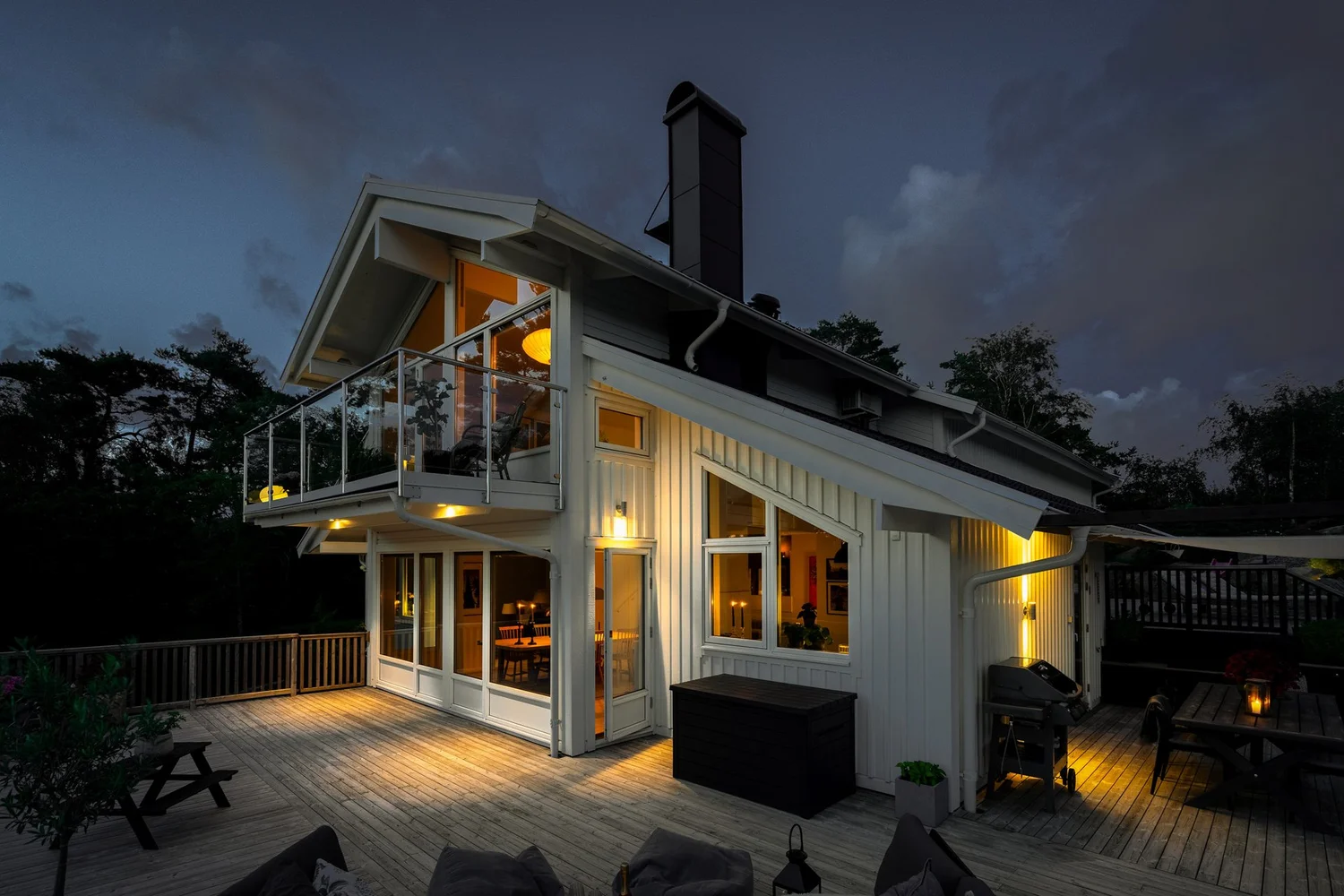
You've found a house in Bohuslän, the köpekontrakt (purchase contract) is signed and the tillträdesdag (completion day, when the house becomes yours) is set. On the phone, the mäklare (estate agent) quickly gives you a few last tips: register for electricity, change your address with Skatteverket, "och så hemförsäkringen, glöm inte den" (and the home insurance, don't forget that). You nod. You already have a hemförsäkring from your old rented flat, and it'll just carry on. Done.
Except: it isn't enough. Not even close.
Almost everyone in Sweden who goes from tenant to homeowner falls into the same gap. In Germany, for example, you take out building insurance and that's it: it covers the building, and your contents insurance covers what's inside. In Sweden the system works differently. Hemförsäkring (home insurance) covers your belongings, personal liability, legal protection and a travel component. For the building itself, you need a separate villaförsäkring (also called småhusförsäkring) or a combined villahemförsäkring, and without it the most expensive asset of your life stands completely unprotected.
This article clears things up: what the two policies do, what they cost, which providers are worth considering, and which three mistakes I keep seeing, in my own case and among other newcomers I know, in the first twelve months.
The insurance has to be in place from the day the house is handed over. Where that day falls in the process is explained in my overview of how buying a house in Sweden works.
Why Sweden has two policies, not one
Swedish insurance logic draws a strict line between what you own and take with you (belongings, furniture, electronics, bikes) and the building itself (walls, roof, heating, fitted bathrooms, garage).
Hemförsäkring covers the first part. In practice it's mandatory for every household in Sweden: many landlords, bostadsrättsföreningar (housing associations) and banks require it in writing. Contents insurance elsewhere covers something similar, but hemförsäkring does more: built-in liability and legal protection, a travel component for up to 45 days, sometimes even an identity theft module. You need it as a tenant, as the owner of a bostadsrätt (cooperative flat) and as a homeowner.
Villaförsäkring covers the second part, and only that. It protects:
- the structure of the building (walls, roof, foundations)
- fixed installations (heating, hot water, electrical wiring, bathrooms)
- outbuildings on the plot (garage, carport, garden shed, pool, sauna)
- damage from fire, water, storms, burglary, lightning
- in most policies: liability as a homeowner ("villaägareansvar") and legal protection for property matters
What it does not cover: your belongings. If your house is ruined by water damage, the villaförsäkring pays for the wall, the bathroom and the heating, but not for the bed, the books and the sofa inside. That's what the hemförsäkring is for.
Most providers bundle both into a combined package: villahemförsäkring. One policy, one premium, both risks covered. That's usually the better route, because in practice claims almost never split neatly into "building" and "contents", and as soon as two insurers are involved, settling the claim takes considerably longer.
What a villaförsäkring costs in and around Gothenburg in 2026
The range is wide and depends on three factors: the type and age of the house, its location, and the excess (självrisk).
Realistic annual premiums for a combined villahemförsäkring on a typical Swedish detached house, 130–160 m², built between 1960 and 2000, in or around Gothenburg:
- Standard policy: 4,500–6,500 SEK a year
- Comprehensive policy (lower excess, broader water damage cover, allrisk): 6,500–9,500 SEK a year
- Premium / Stora Hem: 9,500–13,000 SEK a year
An older house in Bohuslän, close to the coast, with a crawl space (krypgrund) and a timber façade, will be towards the top end. A modern terraced house in Mölndal on a concrete slab, towards the bottom. The excess is typically 2,500–5,000 SEK per claim. For water damage in a bathroom more than 30 years old, it can rise to 10,000–25,000 SEK, depending on the policy. That's one of the most important numbers in the contract, and precisely the one most quietly tucked away in online comparisons.
Four providers dominate the market:
Länsförsäkringar: organised regionally (Länsförsäkringar Göteborg och Bohuslän for the west coast). Locally rooted, with claims handled by real case handlers on the ground. Traditionally very strong in Bohuslän and Gothenburg, where almost every other homeowner is with them. Tends to be slightly more expensive, but with noticeably better customer care when you make a claim, and that's the moment that counts.
Trygg-Hansa: the largest private provider, modern online interface, quick quotes. Solid, but when you claim it's more phone hotline than personal contact.
Folksam: a cooperative, traditionally cheap on the base premium but with higher excesses. Good for young families on a tight budget.
If: active across Scandinavia, very digital, premiums in the mid to upper range. Communicating with them in English is realistically possible, which is a real advantage in the first few months if you don't speak Swedish.
My own instinct: go with Länsförsäkringar for the first two years, settle in properly, then switch if it makes sense after a proper comparison of how claims are handled.
The three mistakes newcomers almost always make
Mistake 1: simply letting the old hemförsäkring from your rented flat carry on.
A hemförsäkring is tailored to a specific type of home: rented flat, bostadsrätt or owned house. If you have a hemförsäkring for a 60 m² rental and move into a 140 m² house without telling your insurer, you keep paying the same premium, but if you make a claim, you're only paid out according to the original policy. That's not bureaucratic hair-splitting. That's a real 100,000 SEK gap after a fire.
Call your insurer on the tillträdesdag, change the type of home, update the floor area, get the new policy confirmed. Ten minutes.
Mistake 2: not checking the water damage terms.
Water damage isn't the most common type of claim in Sweden, but it's the most expensive. It accounts for just under a fifth of all property damage in private households and almost a third of what insurers pay out: around 60,000 cases a year, most recently just under 3.5 billion kronor, sixty per cent more than ten years earlier. Where it happens has shifted too: for seven years in a row, the kitchen has been hit most often, not the bathroom. Old pipes, new appliances. Where it does happen in the bathroom, 44 per cent of cases are down to the tätskikt (waterproofing membrane) and 29 per cent to the connection to the floor drain.
Leaking joints, a burst heating pipe, a faulty dishwasher connection, and then comes the second hurdle. Most providers' standard policies only pay the full damage if the bathroom or pipe concerned is under a certain age (typically 20–30 years). Older? Then an age deduction (åldersavdrag) applies, which can quickly swallow 50–70 per cent of the payout.
If you buy a house with a bathroom from 1995, the water damage cover on a standard policy is practically worthless. The "comprehensive" or "stora" policies reduce the age deduction considerably. The extra 1,500–3,000 SEK a year is the one insurance decision in a house purchase that genuinely pays off for most older houses.
Mistake 3: underestimating the allrisk component.
Allrisk (also called drulle) covers the typical everyday accidents that don't fit into any standard type of damage: a laptop falls off the table, a child throws a phone into the toilet, glasses break while skiing. In a hemförsäkring it's often optional. In a villaförsäkring it covers similar accidents to the building: a tool drops onto the parquet, a glass smashes the sauna's glass door.
In Germany, for example, there's no direct equivalent. Newcomers see the extra 500–800 SEK on the premium and dismiss the option as an overpriced extra. Anyone who has ever had to pay for a scratched oak floorboard or a cracked ceramic hob without allrisk thinks differently about it.
When you need to take out the policy, and when it kicks in
The rule of thumb: until the tillträdesdag the seller carries the risk for the building; from the tillträdesdag you do (Jordabalken chapter 4, section 11), unless the köpekontrakt says otherwise. Check that clause before you sign.
Until then, the seller is still insured. But as soon as the tillträdesdag arrives, the seller's insurance ends automatically. There's no gentle handover, no transition period. If your own policy only starts two days later, you have an uninsured house for two days.
A practical sequence: get three quotes two to three weeks before the tillträdesdag (Länsförsäkringar, Trygg-Hansa, and a third provider), sign the policy at least a week beforehand, and set the start date exactly on the tillträdesdag. To take out the policy, most providers only need the address, floor area, year of construction and your personnummer, with no technical inspection of the house in advance.
If you don't have a personnummer yet (for example with cash purchases using a samordningsnummer, the coordination number), Trygg-Hansa, Folksam and Länsförsäkringar will still accept the policy. You then add the personnummer afterwards, once you have it. It's one of the few places in the Swedish system where that works.
What else you may need in the first year
Two additions (and one you don't need as a homeowner) that usually aren't included in standard policies but become relevant for many types of house:
Bostadsrättstilläggsförsäkring doesn't apply to homeowners. It's only needed by members of a bostadsrättsförening, in other words owners of flats.
Eget vatten och avlopp (private water and sewage): if your house has its own well or its own septic system (common with stugor in Bohuslän, Dalsland, Småland), you need a special add-on. Damage to the well, the pump or the septic system is explicitly excluded in standard policies. Installing a new septic system costs 120,000–250,000 SEK; the add-on is 600–1,200 SEK a year.
Bryggförsäkring (jetty insurance): if a jetty comes with the property (a classic on the west coast), it's rarely covered by the standard policy. Folksam explicitly excludes bryggor (jetties) from storm cover, along with sjöbod (boathouse shed), båthus (boathouse) and badhytt (bathing hut); with Dina, a jetty on someone else's land is capped at 50,000 kronor. And in both sets of terms, a storm only counts from 21 metres per second; anything that happens below that, you pay yourself. That's exactly the gap the January storm falls into: nationwide, storm damage is by far the most common type of natural damage, but on average it only costs 33,500 kronor. Too small for anyone to care about, big enough to hurt. Add-on: 400–900 SEK a year. Which company excludes what is in the terms and conditions, and if you have a jetty, that's exactly the clause worth reading.
What you should do now
If you've just bought a house in Sweden or are about to:
Get three quotes: Länsförsäkringar (your regional company), Trygg-Hansa or If, and a cooperative provider like Folksam. Don't compare the annual premium; compare the water damage terms, the excess and whether allrisk is included. Make sure the policy start date falls exactly on the tillträdesdag. And only cancel your old building insurance back home once the Swedish policy has been confirmed in writing. Being double-insured for a week costs nothing; a gap of one day could cost you six figures.
If you're only just thinking about buying a house: build the insurance costs into your monthly budget. 4,500–8,000 SEK a year means 375–670 SEK a month. It's the item most first calculations forget, and it raises the monthly cost of owning by a noticeable three to five per cent.
Buying a house in Sweden: practical guide, the in-depth guide on this topic (currently available in German): view it in the shop.
I'm Sebastian Schiefner, a photographer in Gothenburg, and I help people who are moving to West Sweden with finding a home and buying property. Free intro call.
