Kivra and the digital mailbox: why your Swedish official mail never reaches your letterbox
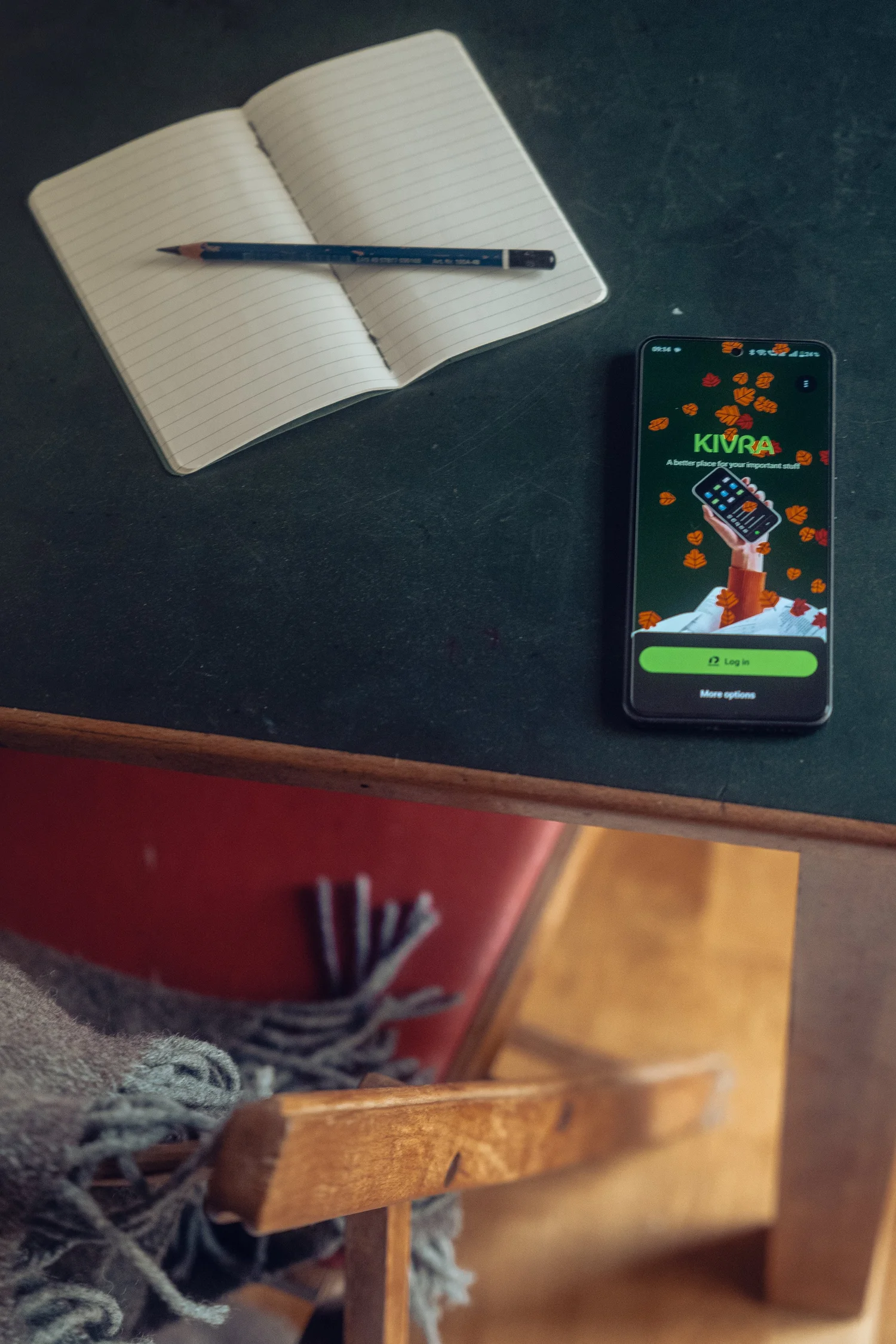
The letterbox stays empty. Not for one day, but for weeks. You have your personnummer, you're folkbokförd (registered in the population register), you've set up an account with Skatteverket, and still nothing arrives from the authorities. No decision, no confirmation, nothing.
That isn't a glitch in the system. That is the system. Your mail is somewhere else, in a place you first have to set up yourself.
The Swedish state sends mail to an account, not an address
Behind digital mail from the authorities sits a service called Mina meddelanden (My messages), run by Digg, the Myndigheten för digital förvaltning (Agency for Digital Government). Mina meddelanden isn't a mailbox but a relay: you choose a digital mailbox, set it up with your e-legitimation (electronic ID), and from then on all connected senders send their mail there instead of on paper.
Connected senders include Skatteverket, Försäkringskassan, Kronofogden, Transportstyrelsen, Pensionsmyndigheten, CSN and Migrationsverket, plus municipalities, regions and municipal companies. Digg itself names two limitations: some senders send everything digitally, others only certain types of document, and in any case you only get mail from the bodies you actually deal with.
Three mailboxes are free and connected to Mina meddelanden: Kivra, Billo and Min myndighetspost. Min myndighetspost is run by Digg itself and only accepts mail from public bodies. Kivra and Billo also accept invoices from companies. As a private individual, you can only have one of them active at a time, so it's a real decision, not something you run side by side.
Kivra is the de facto standard
Kivra has been around since 2011. On its own website, the company cites just over six million users and more than 60,000 senders; at the beginning of October 2026 the figure shown there was 6,514,727. With just under eleven million inhabitants, Kivra's own way of putting it is that roughly every other Swede uses the service.
These are the company's own figures, not official statistics; no authority counts this. But the order of magnitude explains why "skicka det till min Kivra" (send it to my Kivra) is a normal sentence among colleagues here, and why tradespeople, insurers and landlords ask for it as a matter of course.
I use Kivra myself. Not out of conviction, but simply because almost every sender I deal with in Gothenburg sends there. If you choose one of the other two, you're not doing anything wrong. You'll just find yourself explaining it more often.
For you as a user, the service is free; that's stated in the terms of use. Only extra services that you actively add cost money.
No personnummer, no Kivra
This is where it really matters for newcomers. Section 2.1 of Kivra's general terms, in the version valid from 11 April 2026, says: you can sign up if you have a Swedish personnummer and an e-legitimation supported by Kivra, minimum age 18. According to this wording, a samordningsnummer (coordination number) isn't enough.
That sets the order, and it only works in this direction: first the personnummer from Skatteverket, then a bank account and BankID, then the digital mailbox. If you're still getting by with a samordningsnummer, you'll stay on paper mail for the time being. Min myndighetspost also requires an e-legitimation, so there's no way round digital identity there either.
It sounds like a formality, but it's the reason the first weeks in Sweden feel so sluggish: almost every next step hinges on the personnummer. The right sequence is in the authorities roadmap for your first month.
For comparison: Germany currently has nothing like it
To take Germany as an example: its attempt was called De-Mail, and it's being wound up. The recommendation of the Bundestag's Committee on Internal Affairs in printed paper 21/6089 of 21 May 2026 provides for the repeal of the De-Mail Act with effect from 31 December 2026. The reasoning: for secure, confidential and verifiable business communication, there are now European-regulated solutions under the eIDAS Regulation, so a special German law is no longer needed. This saves the BSI (Germany's Federal Office for Information Security) around €63,000 a year from the 2027 budget year.
The real difference, though, isn't the technology but the organisation. In Germany, the paper letter is the norm, and every authority runs its own portal. In Sweden, there's one central relay that everyone is connected to, and you sign up exactly once. That's convenient, and it shifts the responsibility onto you.
What comes in, and why it matters for deadlines
For the digital brevlåda (mailbox), Skatteverket lists, among other things (as of 14 September 2026): the inkomstdeklaration (income tax return) as a PDF, statements and balance notices from your tax account (skattekonto), decisions on preliminary tax (preliminärskatt) and on fastighetstaxering (property tax assessment), payment requests and betalningskrav (demands for payment), confirmations of address changes in the folkbokföring, hemvistintyg (certificates of residence) and notices about trängselskatt (congestion tax), fordonsskatt (vehicle tax) and vägavgift (road charges).
Transportstyrelsen sends digitally (as of 24 July 2026): vehicle tax decisions including reminders, mail about your driving licence and körkortstillstånd (learner's permit), decisions on congestion tax and infrastructure charges, administrative fees, late payment fees, kontrollavgifter (penalty charges) and number plate fees.
Now for the sentence people skim over. Section 2.14 of Kivra's terms says a message counts as received by you as soon as it's available in your digital mailbox, and that you're responsible for going through it, just as with physical mail. The same logic is in the Delgivningslagen (Service of Documents Act): "Delgivning har skett när den eller de som är delgivningsmottagare har tagit emot handlingen" (service has taken place when the recipient or recipients have received the document) (section 18). Whether you open the app makes no difference. The deadline runs from delivery, not from when you read it.
There's one grey area: whether a digital mailbox counts as the "last known address" for the purposes of förenklad delgivning (simplified service) hasn't been settled by the courts, according to a memorandum from SKR, the association of municipalities and regions, from February 2025; Digg takes that view, but a legislative proposal on it wasn't pursued. In everyday life, this doesn't change the outcome, but don't claim you never got the letter.
Practical consequence: switch on push notifications, ideally on the day you set it up. The difference between a digital mailbox and a folder you forget about is exactly that notification, and unlike the letterbox outside your house, nobody comes along and stuffs it so full that you notice. Still, check it yourself once a week.
1 March is the only hard date of the year
If you want your tax return digitally rather than on paper, you need the mailbox by 1 March at the latest. That's what Skatteverket says for 2026: "Sista dag att skaffa digital brevlåda för att få deklarationen dit i stället för med posten" (last day to get a digital mailbox to have the return sent there instead of by post). It's sent out from 2 to 6 March. If you don't have a mailbox, you'll get the return by post by 15 April at the latest.
A point people often get wrong: the mailbox doesn't give you exclusive access. From 6 March, the return is available as a PDF on Mina sidor (My pages) anyway, and you can file from 17 March with your e-legitimation, entirely without Kivra. The early refund on 7 to 10 April doesn't depend on the mailbox either, but on you having approved the return by 31 March without changing anything. What the mailbox saves you is six weeks of waiting for an envelope and wondering whether it'll arrive.
The dates above apply to 2026; Skatteverket publishes them afresh every year, but the structure has stayed the same for years. How the return itself works is explained in my article on the inkomstdeklaration, and what comes afterwards in the one on the slutskattebesked (final tax statement).
Enskild firma: a detail that catches people out
Kivra's företagsbrevlåda (business mailbox) is available for aktiebolag, handelsbolag, kommanditbolag, ekonomisk förening, bostadsrättsförening and idrottsförening. It is not available for enskilda firmor (sole traders) and ideella föreningar (non-profit associations). Kivra says so explicitly in its own help pages and refers owners to the private mailbox.
That makes sense, because the organisation number of an enskild firma is the owner's personnummer. In practice it means: business invoices and private mail land in the same inbox, and you have to sort them yourself. I run an enskild firma and use Kivra, and that's exactly how it is for me; there's no second inbox. If you're used to keeping business and private mail strictly apart, plan for this before your first round of bookkeeping.
What you should actually do
First: personnummer, then bank and BankID. It doesn't work before that, and every attempt to shortcut the order fails right there.
Second: choose one mailbox, and only one. Kivra, if you also want company invoices digitally and prefer the most widely used service; that's the one I'm with. Min myndighetspost, if you only want mail from the authorities and would rather see it run by a public agency than a private company.
Third: switch on push notifications. Delivery counts whether you read it or not.
Fourth: this doesn't mean paper mail is over. Registered letters with mottagningsbevis (proof of receipt) and court service still come physically. What that means for longer absences is explained in my article on mottagningsbevis and postfullmakt.
Fifth, for later: if you ever close the mailbox, download whatever you want to keep first. With Min myndighetspost, an inactive brevlåda is automatically closed after 18 months without use, and its contents are deleted.
In Sweden, an empty letterbox outside your house isn't a sign that nothing is happening. It's a sign that you haven't yet checked where your mail really is.
Complete package: moving to Sweden, the in-depth guide on this topic (currently available in German): view it in the shop.
I'm Sebastian Schiefner, a photographer in Gothenburg, and I help people who are moving to West Sweden with finding a home and buying property. Free intro call.
