Lucia, julbord and advent: the Swedish December for first-timers
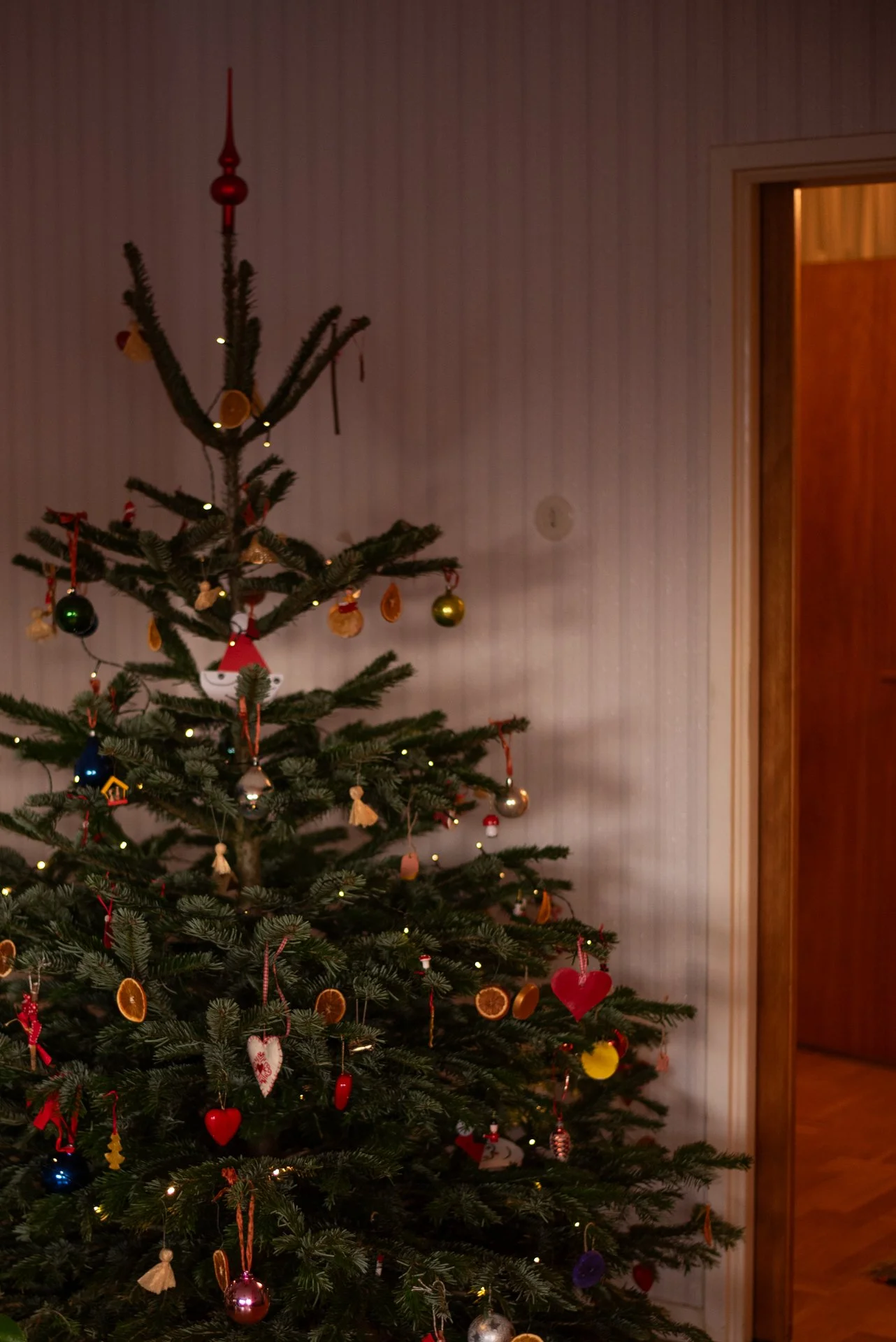
The first of December in Sweden feels like a season, not a month. It is dark by half past three, there are lights in the windows, and at some point in November someone at the office starts talking about a julbord (the Swedish Christmas buffet) that you have apparently already signed up for.
Most of it is nicer than you would expect. Two or three things work differently from the calendar you carry in your head (in Germany, for example, that means the one with the Adventskranz and the Weihnachtsmarkt), and they cost you nerves if you only notice on 24 December.
2026 is a poor year for public holidays
Let's start with the news you need early, because it is holiday planning.
Which days count as public holidays in Sweden is set out in the Lag (1989:253) om allmänna helgdagar, the law on public holidays. For December the law names exactly two: juldagen, 25 December, and annandag jul, 26 December, expressly "även när de inte infaller på en söndag" (even when they do not fall on a Sunday). Plus all Sundays.
Julafton, 24 December, is not in the law. The most important festive day of the year is not a public holiday in Sweden. In practice almost everyone has it off, but that is settled by employers and collective agreements, not by the state. If you are new in a Swedish job: ask before you book the flight.
And 2026 falls awkwardly. Julafton is a Thursday, juldagen a Friday, and annandag jul falls on a Saturday. The only public holiday that wins you a working day is therefore 25 December. If you want a whole week in a row, you take leave.
This year Lucia coincides with the third Sunday of advent
13 December 2026 is a Sunday and at the same time the third Sunday of advent (advent being the four Sundays before Christmas). The two do not line up every year. Lucia is not a public holiday; 13 December does not appear in the law. This year the day is off only because it is a Sunday.
What to expect: a procession of singers dressed in white, led by a figure with a wreath of lights in her hair, followed by tärnor (handmaidens), stjärngossar (star boys) and sometimes pepparkaksgubbar (gingerbread men). That is how the Institutet för språk och folkminnen (Isof, the Institute for Language and Folklore) describes it. The stjärngossar represent the Three Wise Men.
Two things that tend to surprise newcomers. First, lucia is written with a small l: Isof's Frågelåda (its question box) makes clear that only the personal name takes a capital, not the figure or the day. Second, the Swedish custom has barely anything to do with the Sicilian saint: "Det svenska luciafirandet har dock egentligen ingenting att göra med det sicilianska helgonet." The oldest known description of a Lucia dressed in white comes from Västergötland in the 1760s, so from here, from West Sweden. The custom went public at the end of the 1920s through a newspaper competition in Stockholm.
Lussekatter belong to it: saffron-yellow, S-shaped yeast buns. A West Swedish detail from the Isof archive: in the western parts of the country the pastry used to be called dövelskatt, "devil's cat".
The widespread claim that Lucia processions take place at seven in the morning is something I have not been able to verify anywhere. All that is historically documented is the motif of the morning visit.
If you want to see Gothenburg's Lucia: book now
The best-known Lucia celebration in the city takes place in the Göteborgs domkyrka (Gothenburg Cathedral), and it takes place five times: Thursday, 10 December at 19.00, Saturday, 12 December at 16.00 and 19.00, Sunday, 13 December at 15.00 and 18.00, sung by the choirs of the Domkyrkan.
Admission is not free. Tickets are available through KS Biljettservice, and ticket sales opened on 23 October at 16.00. If you drop in on 13 December on the spur of the moment, you will find a full house. This is the most concrete date in this whole article.
Whether your child's förskola (preschool) or school celebrates, when, and whether parents are asked to bring anything is decided by each institution itself. There is no central rule from the city. Ask there, not on the internet. The framework, on the other hand, can be planned: the Höstterminen (autumn term) in Gothenburg ends on 18 December 2026, and the Vårterminen (spring term) begins on 11 January 2027. That is three weeks of Jullov (Christmas break) that need looking after. How this fits with the rest of the school year is covered in the article on moving to Gothenburg with children.
Julbord: what is real and what is only hearsay
The julbord is a buffet, and it has a Catholic heritage. Isof describes why fish and bread (lutfisk, herring, salmon) are still on it today: they come from the fasting period, which only ended on juldagen. Ham and sausage were originally reserved for Christmas Day.
Now for the point where almost every German-language text claims something that cannot be verified: the famous "rounds" of the julbord, first herring, then cold fish, then cold cuts, then hot dishes, and cheese at the end. Neither Isof nor the Nordiska museet describes a fixed order. You find it with caterers and in travel blogs, not in the historical record. That many restaurants serve it that way today is true. That it is tradition is not documented.
No authority says when the season runs either. One hard data point at least: Liseberg takes julbord bookings for selected days between 14 November and 23 December 2026. That is roughly the window in which the city as a whole eats julbord.
For employers and the self-employed: the 2026 figures
If you have staff in Sweden, you should know the tax rules before booking a julbord. They are stricter than they look. I run an enskild firma (sole proprietorship) without employees, so there is nobody for me to throw a personalfest (staff party) for; as soon as there is staff, the following applies.
A julbord for the workforce counts as internal representation. For this, Skatteverket allows "avdrag för personalfest … för högst två fester per år" (a deduction for a staff party, for at most two parties per year). For income tax purposes, the food itself is deductible at SEK 0: since the 2017 reform there has been no deduction for it. Only the incidental costs, such as room hire and music, are deductible, at SEK 180 per person excluding VAT.
The real advantage lies with VAT (moms). The basis for food and drink is at most SEK 300 per person and occasion excluding moms; if you are above that and the meal has both food and alcohol on the bill, you can deduct a standard amount (schablon) of SEK 46 per person. Without alcohol the schablon does not apply; the actual moms is then calculated.
A trap I have not found described correctly on any advice portal: since 1 April 2026 VAT on food has been cut from 12 to 6 per cent, temporarily until the end of 2027, but on restaurant services it stays at 12 per cent. The classic julbord in a restaurant therefore still falls under the SEK 46 schablon, not under the lower one of SEK 33.
And the Christmas present: a julgåva up to SEK 600 including VAT is tax-free in 2026, SEK 50 more than the year before. The small print matters here: this is a threshold (Freigrenze), not an allowance. "Om värdet på gåvan överstiger det skattepliktiga beloppet är gåvan skattepliktig från första kronan." (If the value of the gift exceeds the taxable amount, the gift is taxable from the first krona.) A gift worth SEK 620 becomes taxable from the first krona.
The amounts above are the figures Skatteverket has published for 2026, as of October 2026. They change every year, and whether a specific case falls under them depends on details that cannot all be given here. I am a photographer, not a tax adviser. So before booking, check briefly with Skatteverket or ask your accountant (redovisningskonsult).
23 December is your last shopping day
Systembolaget (the state-run alcohol retailer) has published its holiday opening hours for 2026, and they are unambiguous: on 24, 25 and 26 December it is closed, three days in a row. On 22 and 23 December all branches are open until at least 19.00, and on Nyårsafton (New Year's Eve) only until 15.00. Local deviations are possible.
13 December is a Sunday, and on Sundays it is closed anyway. How the shop works in general is explained in the article on Systembolaget.
Then there is the point where habits from home can become dangerous. The limit for rattfylleri (drink driving) is 0.10 milligrams of alcohol per litre of exhaled air, according to the police roughly 0.2 per mille, compared with 0.5 in Germany, for example. The penalty: a fine or up to six months in prison. From 0.50 mg/l, about 1.0 per mille, it is grovt rattfylleri (gross drink driving), with up to two years. In practice that means: one glass of glögg (mulled wine) at the julbord, and the car stays where it is.
But the night bus will not get you home on Christmas Eve. Västtrafik runs a Saturday timetable on Julafton, within Gothenburg, Mölndal and Partille as on a Sunday, and without night services. On 25 and 26 December there are night services again.
Advent is a German import
Finally the twist I like best, because it reverses the direction of the usual story.
The adventsljusstake (advent candle holder) and the adventsstjärna (advent star) that stand in practically every Swedish window from the end of November are, according to the Nordiska museet, not a Swedish invention: "Både adventsljusstaken och adventsstjärnan har tyskt ursprung." (Both have German origins.) The advent star originated in the 1880s in Herrnhut in Upper Lusatia and only spread in Sweden from the 1930s. The first advent calendar, too, was printed in Germany at the beginning of the 20th century.
The first Sunday of advent in 2026 falls on 29 November. That follows from the definition (the fourth Sunday before Julafton); Svenska kyrkan itself does not name a date. It marks the start of the church year.
What happens after that on 24 December has a choreography of its own: at 15.00 "Kalle Ankas jul" has been on SVT since 1960, lunch comes before it, and afterwards the tomte (the Christmas gnome) arrives with the presents. Since 2021 the Julvärd (host) opens the window at 15.00, and the cartoon starts at 15.05. The 2026 programme had not yet been published when this was written.
What belongs in your calendar now
Four dates, and the rest follows.
Now: Lucia tickets for the Domkyrka, if you want to go. Ticket sales have been open since 23 October.
29 November: first Sunday of advent. From here the city is lit up, and the julbord window is open.
13 December: Lucia, this year a Sunday and the third Sunday of advent.
23 December: the last day at Systembolaget before three closed days, and the last day of school is the 18th.
The rest is darkness with candles in it, and after a few weeks that is less a shortcoming than a method. There is more on that in the article on the Swedish winter in Gothenburg. How the other great light moment of the year works, when the fires burn in April, is covered under Valborg.
Komplettpaket: Umzug nach Schweden (the complete relocation package): the in-depth guide on this topic, view it in the shop. The guide is currently available in German.
I'm Sebastian Schiefner, a photographer in Gothenburg, and I help people who are moving to West Sweden with finding a home and buying property. Free intro call.
