Styr & Ställ: Gothenburg's city bikes for newcomers
It's your first week in Gothenburg. You don't have a personnummer yet, no Swedish bank account, no BankID, so no Västtrafik travel pass in the app either, because the Swedish system seems to ask you for exactly those things at every turn. And yet somehow you need to get from your new flat in Majorna to Skatteverket in the city centre, to friends in Linnéstaden in the evening and over to Hisingen at the weekend to pick up furniture.
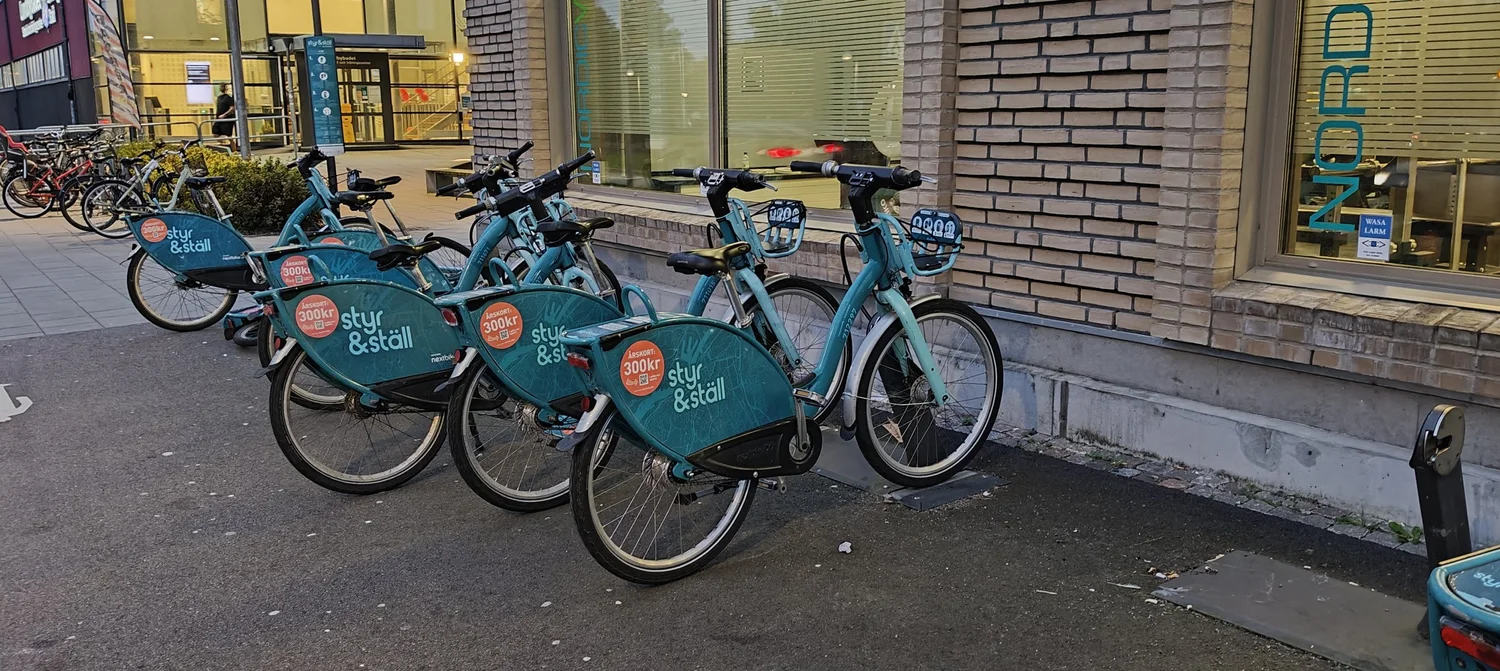
The Swedish answer is standing on almost every bigger street corner: light blue bikes in a row at a small station, with a QR code next to them. That's Styr & Ställ, Gothenburg's municipal bike-share scheme. It's one of the few transport services in Sweden that simply lets you ride off on day one, without a personnummer and without BankID. And for many newcomers it's the cheapest and fastest way to get to know the city, long before all the official paperwork has gone through.
Gothenburg is built for it: flat, compact and criss-crossed with cycle paths. What would be hard work in a hilly city like Stockholm is a relaxed quarter of an hour here. This article explains how Styr & Ställ works, what it costs in 2026, how to sign up, where the pitfalls are, and when it really pays off compared with a tram pass or your own bike.
What Styr & Ställ is (and what it isn't)
Styr & Ställ is the City of Gothenburg's official bike-share scheme, operated by nextbike. The network of stations covers Gothenburg and, since the most recent contract round, extends beyond the city boundary to Mölndal; the app shows the current number of bikes and stations. The principle is simple: you take a bike from a station, ride wherever you want and return it to any other station. It's not a bike you hire for a whole day, but for a single trip from A to B.
Two things newcomers often get wrong:
These are normal bikes, not e-bikes. If you're used to electrically assisted hire bikes from other cities, Berlin or Hamburg for example, it's worth knowing. Styr & Ställ currently only offers classic pedal bikes with three gears. In flat Gothenburg that's enough almost everywhere. Only if you regularly have to get up to Guldheden or one of the few other real climbs will your calves notice the difference.
It's a station-based system, not free-floating. You can't just leave the bike at the side of the road like an e-scooter. It has to go back to an official station. If you leave it somewhere else, it costs a service fee of at least 200 SEK. In the city centre there are also so-called flex zones, where the rules for returning a bike are a bit looser, but as a rule of thumb: the bike goes back to a station.
What it costs, and why 300 kronor a year sounds almost too cheap
This is where the real charm of the system lies. The prices (as of 2026):
- Annual pass (årskort): 300 SEK, roughly 26 euros. For the whole year.
- Monthly pass (månadskort): 90 SEK.
- Without a pass (single ride): 20 SEK per started 30 minutes.
- Students: 25 % off the annual pass, so 225 SEK. The offer runs through Mecenat.
The crucial point is in the small print, and it makes all the difference: with an annual or monthly pass, the first 60 minutes of every new ride are free. Only after that does each additional started half hour cost 10 SEK. And in Gothenburg hardly any sensible trip across town takes longer than an hour.
Do the maths: you pay 300 SEK for the annual pass. As long as you end every ride within 60 minutes, docking the bike at a station before the hour is up, you effectively ride for free for the rest of the year. You can also dock at a station along the way and take a new bike, and the hour starts again. If you live in the centre and do a few short trips every day, it's by far the cheapest way of getting around this city: cheaper than a month of Västtrafik, cheaper than any fuel, cheaper than boendeparkering for a single weekend.
What a forgotten bike ends up costing is set out in nextbike's rental terms. If you're thinking of leaving a bike out for a whole day, read them before you do.
Signing up: the rare case where Sweden just lets you get on with it
This is the most important part for newcomers, and the pleasant surprise. For almost everything in Sweden you first need a personnummer, then BankID, then a Swedish account before anything works. Styr & Ställ is the exception.
You sign up in the nextbike app (alternatively on the website or at one of the terminals, which in Gothenburg are at Drottningtorget, at Korsvägen and at Mölndals centrum). When you register, you add a payment method: an ordinary credit card or PayPal is enough. No BankID needed, no personnummer, no Swedish account. A one-off deposit of 10 SEK is charged just to verify the card. That amount is credited to your account and deducted from your next purchase. That's it.
After that, every ride works like this: at the station, scan the QR code on the bike with the app, you get a code, enter it on the small on-board computer behind the saddle, and the frame lock pops open. To return the bike, push the cable lock through the front fork, press "OK", done. If you'd rather not use a smartphone, you can also put the pass on an RFID card.
Practical note: customer service is in Swedish and English, and the opening hours are in the app. English is all you need here.
All year round, not just in summer
One thing that's wrong in many older German-language travel blogs: Styr & Ställ is no longer a summer-only service. The bikes used to be collected over the winter months. Since the system was relaunched, they're available all year round. That means you can sign up in November and ride in January, as long as the weather plays along. And in Gothenburg it does so more often than the city's reputation suggests. At minus two degrees on a dry road, the bike is often faster and more reliable than the packed tram at rush hour.
Etiquette and pitfalls: what newcomers easily overlook
A few things newcomers regularly get stuck on:
A full station when you return the bike. Sometimes the station you're heading for is full, with no free slot. Then the clock keeps running until you've found a place for the bike. The fix: check in the app beforehand whether there are free slots at your destination, or head for the next station, which in the centre is rarely far away. If you're cutting it close to the 60-minute limit, build in a couple of minutes' buffer.
"Parking" the bike still costs. During a ride you can activate a parking mode (the P button on the on-board computer) to pop into the supermarket. But careful: the clock keeps running, and the bike doesn't count as returned. If you'll be somewhere for more than a few minutes, you're better off returning the bike at a station and taking a new one later.
Returns only at official stations. The classic mistake: leaving the bike "somewhere sensible" because it happens to be convenient. At least 200 SEK service fee. The app shows you all the stations. Use it consistently to end every ride and check that the ride really has ended.
A maximum of four bikes per account can be hired at the same time, which is handy if there are several of you. The free minutes only apply to the first bike, though; the others run at the normal rate. And the front basket is meant for a few kilos, not for your weekly shop at Willys. The exact limits for load and basket are in the rental terms.
Styr & Ställ, Västtrafik or your own bike?
An honest assessment, because the question comes up after a few weeks anyway:
Styr & Ställ makes sense if you live centrally (Vasastan, Linnéstaden, Majorna, Haga, Centrum), make lots of short trips and don't want a bike in the basement that can get stolen or rust. For 300 SEK a year it simply has no competition. You don't need a parking spot, maintenance, a lock or winter storage.
Your own bike makes sense if you ride long distances or the same route every day, need a child seat or trailer, or live in a neighbourhood without a dense network of stations. Second-hand bikes are cheap on Blocket and at loppis (flea market) sales from spring onwards. Just be sure to budget for a solid lock: bike theft in Gothenburg is real.
Västtrafik (tram, bus, ferry) is the complement, not the competition: for rain, for distances over five kilometres, for Hisingen, and for winter, when the bike gets too cold for you after all. Lots of people in Gothenburg use exactly this combination: bike for short trips in good weather, tram for everything else. The good news: Styr & Ställ runs completely independently of the Västtrafik system, so you don't need one to use the other.
In short: what you can do this week
- Download the nextbike app and register with a credit card or PayPal. You can do that today, without a personnummer and without BankID.
- Buy the annual pass for 300 SEK straight away if you're staying longer than three or four months. Compared with single rides, it pays for itself almost immediately.
- Are you a student? Get the Mecenat discount and pay only 225 SEK.
- Look in the app for the stations around your flat and your usual destinations. If there are enough of them, you don't need a bike of your own for now.
- Remember the one rule that saves money: keep each ride under 60 minutes and dock at a station. With an annual pass, you then ride practically for free.
Styr & Ställ isn't a complicated system. It's just one of the few in Sweden that doesn't put you through the bureaucratic mill before you're allowed to use it, and that's exactly why it's a perfect first step for getting to know Gothenburg in your first weeks instead of despairing over the tram map. Grab a bike and ride along the water. This city opens up best from the saddle.
Read more on Nordabenteuer:
- Boendeparkering in Gothenburg: if you're coming with a car after all
- The best neighbourhoods in Gothenburg: which one suits you
- The cost of living in Sweden: an honest comparison
Planning your move to Gothenburg and want to tackle the first steps in the right order? Book a free 15-minute intro call.
Buying a house in Sweden: practical guide, the in-depth guide to this topic (currently available in German): view it in the shop.
I'm Sebastian Schiefner, a photographer in Gothenburg, and I help people who are moving to West Sweden with finding a home and buying property. Book a free intro call.
