Tomträtt in Sweden: what a site leasehold really costs when you buy a house
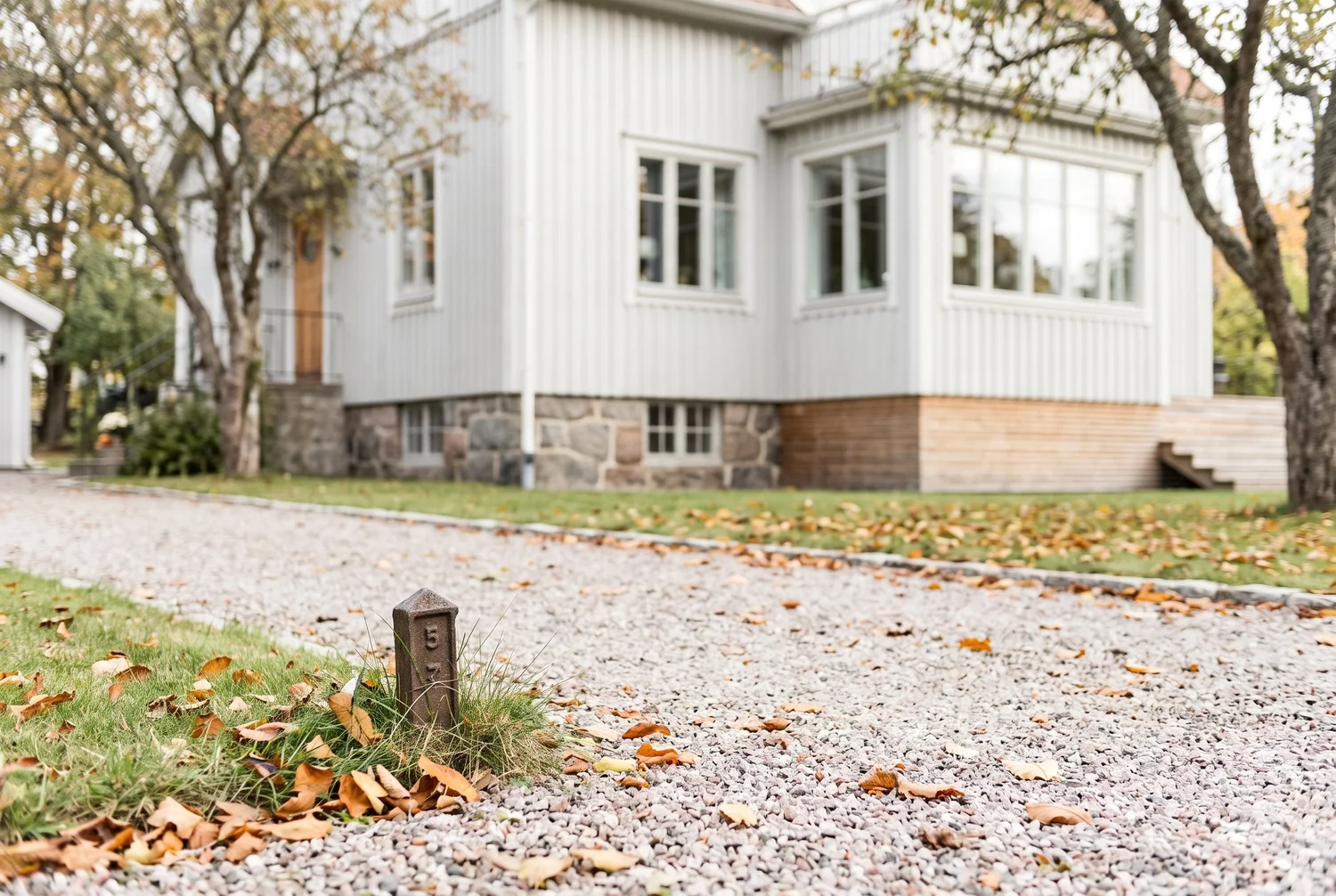
There is a word in the listing that foreign buyers skim over because it looks like information about the size of the plot: tomträtt. It means the house belongs to you and the land beneath it does not. You pay for it every year, and that amount is reset every ten years: not according to an index, not according to inflation, but according to what the land is worth at the time of the reset.
I moved from Berlin to Gothenburg in 2022 and since then I have photographed several hundred properties a year for estate agents in Gothenburg and on the west coast. Gothenburg is a tomträtt city: as of 28 February 2025, the Exploateringsförvaltningen (the city's land development administration) counted exactly 9,415 residential tomträtter, 8,667 of them single-family houses, and took in around 444 million kronor a year from them. If you're house-hunting here, you'll come across it.
What tomträtt is in legal terms, and what it is not
Chapter 13, section 1 of the Jordabalken (the Swedish Land Code) describes tomträtt as a right to use a property "under obestämd tid för visst ändamål mot årlig avgäld i pengar": for an indefinite period, for a specific purpose, in return for an annual payment in money.
Three things follow from this. There is no date on which the right ends. You may sell and mortgage the tomträtt; that is in the second paragraph of the same provision, and the pantbrev (mortgage deed) works just as it does for a normal fastighet. And only the other side can terminate it: the tomträttshavare (leaseholder) cannot end the agreement on their own initiative.
The owner's rights to terminate, on the other hand, are narrow. Termination is only possible at the end of fixed periods: the first lasts at least 60 years, the following ones at least 40. Notice must be given no more than five and no less than two years in advance, and only if the termination is "av vikt för ägaren", that is, of importance to the owner. If they terminate, they must take over the building from you and compensate you, excluding the land value, which was never yours.
So your security of tenure is high. The uncertainty lies entirely on the cost side.
How the avgäld is calculated: Gothenburg and Stockholm do it differently
Gothenburg calculates in one step: for småhus (single-family houses), 1.05 per cent of the marktaxeringsvärde (assessed land value) applying at the time of the omreglering (reset) for ten-year periods, 1.20 per cent for twenty-year periods. For flerbostadshus (blocks of flats), 1.50 and around 1.69 per cent respectively.
You can check the maths: a marktaxeringsvärde of 2,000,000 SEK gives 21,000 SEK a year, or 1,750 SEK a month. The background: according to the city, the taxeringsvärde is supposed to correspond to 75 per cent of market value and is reset every three years for småhus. So two million in taxeringsvärde means land with a market value of around 2.7 million kronor.
Stockholm calculates in two steps: 3.25 per cent of 40 per cent of the marktaxeringsvärde for ten-year periods, 3.5 per cent for twenty-year periods. With a marktaxeringsvärde of 1,000,000 SEK, this formula gives 13,000 SEK a year.
What matters is what these figures are: municipal political decisions, not legal rules. On 24 April 2025 (T 3706-23), the Högsta domstolen (Supreme Court) set an avgäldsränta (fee rate) of 1.75 per cent of the land's market value for a Stockholm bostadsrättsförening; Gothenburg's own administration describes its småhus model as discounted by about 74 per cent compared with this case law. What you pay today is cheap by political choice, and can therefore be changed by political choice.
The reset every ten years is the real risk
Within a period, the avgäld is fixed. Chapter 13, section 10 of the Jordabalken: "Om ej längre tid överenskommes, utgör varje period tio år." Unless a longer period has been agreed, each period is ten years.
What happens after that is in chapter 13, section 11: the avgäld is set "på grundval av det värde marken har vid tiden för omprövningen", on the basis of the land value at the time of the review. No index, no link to inflation, no cap in the law. If the review is not brought before a court in the second-to-last year of the period and nothing else is agreed, the old amount continues.
The letter arrives well before then: Gothenburg sends out a tilläggsavtal (supplementary agreement) with the new fee about 15 months before the period ends; in Stockholm the letter lands in your letterbox 15 to 18 months beforehand.
Stockholm's own brake shows how big the jumps can be. There, the increase for småhus is capped at a maximum of 18,000 SEK a year (ten-year period) or 19,400 SEK (twenty-year period), and under a decision from 2004 it may never exceed 100 per cent of the previous avgäld. It is phased in: 40 per cent in the first year, then 55, 70, 85, and in full from the fifth year. A city does not build a cap at plus 100 per cent unless there are cases that go above it. I have not found any such cap for Gothenburg; in 2025 the administration was tasked with looking into a maxtak (ceiling).
So the most important question at the viewing is not what the avgäld costs today, but when the period ends. A house with two years left to run is a different offer from one with eight.
What the listing says, and what it doesn't
The list price is the price for the building. The avgäld is not included in it, and the end date of the current period is not one of the details you can rely on in the listing. You have to ask for both; the mäklare (estate agent) has the tomträttsavtal (leasehold agreement). How to read the other fields is explained in the article on Hemnet listings.
Convert the avgäld before you bid: at 4 per cent interest, 21,000 SEK a year corresponds roughly to the cost of an extra 525,000 SEK of loan. Two houses at the same price are not equally expensive if one of them stands on its own land. And because bids in Sweden are not binding, asking before you bid costs nothing.
Buying out the land: 65 per cent of the marktaxeringsvärde in Gothenburg
Gothenburg allows friköp, buying the land. The price "motsvarar 65 procent av det vid tidpunkten gällande marktaxeringsvärdet" (corresponds to 65 per cent of the marktaxeringsvärde applying at the time), provided the tomträtt has existed for more than ten years; for shorter periods, at market price.
The route: an expression of interest with the fastighetsbeteckning (property designation), review of the agreement, an offer, köpekontrakt, payment no later than the tillträdesdag (completion day), köpebrev (deed of purchase), and after that you apply for the lagfart with Lantmäteriet yourself, within three months. Stämpelskatt and administrative costs come on top.
Whether it pays off is a calculation you have to make yourself. With a marktaxeringsvärde of 2,000,000 SEK, the buy-out costs 1,300,000 SEK, while the avgäld is 21,000 SEK a year: around 62 annual fees. At today's heavily discounted rates, buying out therefore mainly makes sense if you expect rising fees or want the land as an asset that goes with the house when you sell. A reduction to 50 per cent is being discussed in Gothenburg, but it has not been decided. Other municipalities have their own rules or don't sell at all: a municipal decision, not a legal one.
Tax, purchase costs, mortgages: where it differs and where it's the same
You still pay the fastighetsavgift (municipal property fee). Skatteverket is clear: "Tomträtt beskattas på samma sätt som fastighet" (tomträtt is taxed in the same way as a property). It remains 0.75 per cent of the taxeringsvärde, capped at 10,425 SEK for 2026 and 10,074 SEK for 2025; new builds with a värdeår (value year) from 2012 onwards are exempt for the first 15 years. The avgäld does not replace this fee; it comes on top.
On the other hand, the avgäld is deductible. Skatteverket lists it in its Avdragslexikon under T: a deduction is possible "om tomten har upplåtits under en viss tid med tomträtt av kommunen" (if the plot has been granted by the municipality as a tomträtt for a certain period), to be entered "vid punkt 8.1 (Ränteutgifter)" (at item 8.1, interest expenses) of the inkomstdeklaration. It works like an interest deduction. An arrendeavgift, that is, a classic lease, is explicitly not deductible, so the distinction pays off for tax purposes too.
For stämpelskatt (stamp duty) there is a separate comparison rule: Lantmäteriet compares the amount paid for the tomträtt with the assessed byggnadsvärde (building value) and taxes the higher of the two, 1.5 per cent for private individuals, plus an expeditionsavgift (processing fee) of 825 SEK. Every new pantbrev costs 2 per cent plus 375 SEK, as usual. In absolute terms you pay less than for an equivalent house with its own plot, because you are not buying the land.
A tomträtt can be mortgaged; the legal route is the same. I have not found any reliable figures on how banks value it for a bolån (mortgage).
A comparison with Germany: the Erbbaurecht looks the same but protects differently
If you know ground leases from elsewhere, you will recognise the model. Germany's Erbbaurecht is a good worked example, because structurally it is the same construction: § 1 ErbbauRG describes a transferable and inheritable right to have a building on or under the surface of a plot of land. If you know the German Erbbaurecht, you will recognise the tomträtt, and then underestimate the difference.
The difference lies in the adjustment. § 9a ErbbauRG explicitly protects residential use: increases are only allowed as far as they are not unreasonable, and as a rule anything that goes beyond general economic developments since the contract was signed counts as unreasonable. Changes in land values are in principle not taken into account, and an increase can be demanded at the earliest three years after the contract was signed or after the last increase.
That is the exact opposite of the Swedish rule: what § 9a ErbbauRG deliberately excludes, the land value, is what chapter 13, section 11 of the Jordabalken makes the basis of assessment. Germany links to the economy, Sweden to the land market. Where land prices rise faster than wages, that is a considerable difference.
Two more differences: the German Erbbaurecht has a contractually fixed end date, while the tomträtt runs indefinitely. And the German Erbbaurecht contract requires notarisation under § 311b(1) BGB and an entry in the land register, whereas there is no notary involved in buying a house in Sweden. The bottom line: Sweden gives you more security of tenure and less security on costs; Germany the other way round.
What to clarify before you bid
Five things, all of which can be clarified before your first bid.
Ask for the tomträttsavtal: purpose, length of the period and above all the end date of the current period, the most important figure in the whole process.
Recalculate from the marktaxeringsvärde, using the municipality's formula. In Gothenburg that is 1.05 per cent; it is unlikely that the taxeringsvärde will stay the same until the next omreglering.
Ask about friköp: whether it is possible at all, and at what price. What applies in the next town does not apply here.
Add the avgäld to your monthly budget, alongside fastighetsavgift, villaförsäkring (house insurance), heating and the energideklaration. Only then can you compare two houses honestly.
Don't forget item 8.1. The city sends a notification to the tax agency, but you have to enter the amount yourself.
Tomträtt is not a trap. It is a price that lies in the future and is not in the listing. If you work it out beforehand, you buy with more peace of mind than someone who is caught off guard by the letter fifteen months before the end of the period.
Buying a House in Sweden: Practical Guide, the in-depth guide on this topic, is currently available in German: view it in the shop.
I'm Sebastian Schiefner, a photographer in Gothenburg, and I help people who are moving to West Sweden with finding a home and buying property. Free intro call.
