Swedish property terms: a glossary
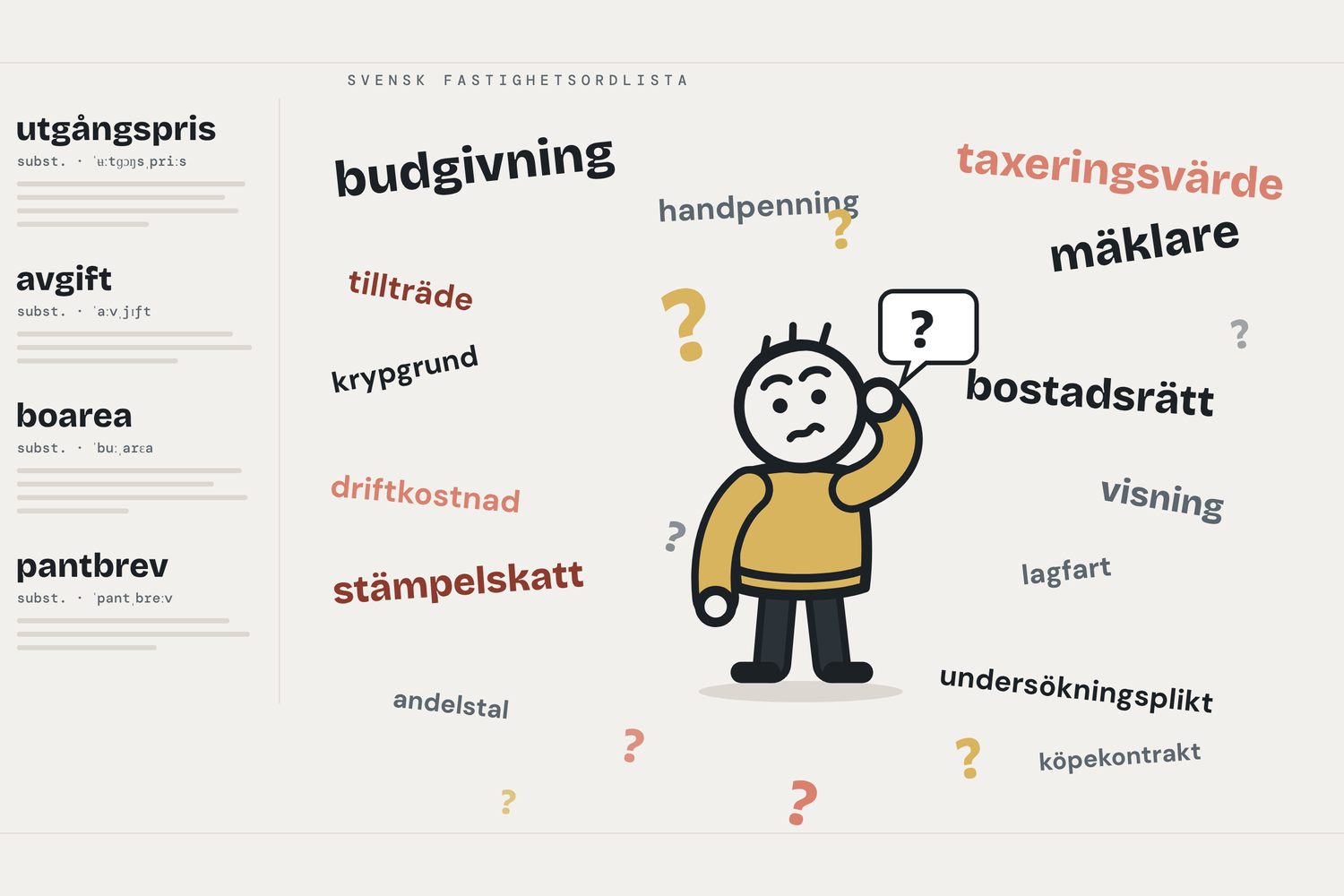
A Swedish listing looks much like a listing anywhere else: photos, price, square metres, year built. That is exactly why it goes wrong. The fields are named differently, and two of them mean something other than what your browser translates them as. This is the list I wish I'd had when I moved to Gothenburg in 2022, to keep next to you while you scroll through Hemnet.
The four terms where it goes wrong most often
Utgångspris: literally "starting price". It is not the price but the starting point of the bidding round. The browser translates it as "price", and that is exactly where a budget that is too small comes from. What is finally paid is the Slutpris, and you only find that out after the sale.
Avgift (or Månadsavgift): the monthly fee paid to the owners' association, for a Bostadsrätt. It is not a simple service charge with a reserve. In Germany, for example, the Hausgeld includes a reserve, whereas the Avgift also contains your share of the Förening's debts. An unusually low Avgift can mean the Förening is managed well, or that its renovation is still ahead of it and the fee will rise afterwards. The number alone tells you nothing.
Boarea (BOA for short) and Biarea (BIA): living area and secondary area. The basement with a window, the converted lower-ground floor, the space under the sloping roof: in Germany, for example, these are partly counted in the living area, while in Sweden they are listed separately. "120 + 40 m²" is not the same as 160 m², and the price per square metre is almost always calculated on the Boarea.
Driftkostnad: the running costs of a house, meaning heating, water, electricity, insurance, refuse. It appears in the listing as an annual amount and is the seller's estimate based on their own consumption. For a family of four following a pensioner who lived alone, the figure will look different in the first winter.
What kind of home is this, anyway?
Bostadsrätt: you don't buy a space but a share in a co-operative, and with it the right to live in that flat. It is comparable to ownership as understood in Germany, for example, but legally it is something different. The normal case in the city.
Äganderätt: genuine ownership of both land and building. The normal case for a detached house, the Villa.
Hyresrätt: a rental flat. It rarely appears on Hemnet; rentals in Gothenburg go through the queue at Boplats.
Tomträtt: leasehold on the land (in German, Erbpacht). The house is yours, the ground is not; you pay a tomträttsavgäld to the municipality, which is reassessed at regular intervals. Often it appears in the listing only as a single word in the fact list, and it changes the sums considerably.
Andelstal: your share of the Förening as a percentage. It determines what part of the shared costs and debts you carry.
Who is the Förening, and why does it matter more than the flat?
Bostadsrättsförening (BRF for short, or simply Föreningen): the co-operative that owns the building. Its finances are your finances. The årsredovisning, the annual report, is public and tells you more about the next ten years than any photo.
Renoveringsfond / underhållsplan: the maintenance reserve and the renovation plan. If the plan foresees a new roof for the year after next and the reserve is thin, it comes back to you through the Avgift.
Äkta and oäkta förening: a tax classification. "Oäkta" has consequences for taxation when you sell. It is rarely in the listing, so it is worth asking.
Money that comes after the purchase price
Handpenning: the deposit that falls due shortly after the contract is signed. In practice usually ten per cent of the purchase price, agreed in the contract and not set by law. It is not a reservation fee: from here on, the purchase is binding.
Stämpelskatt: stamp duty, the tax on the transfer of land, payable only when you buy land, so with a Villa and with Tomträtt. It does not apply to a Bostadsrätt.
Pantbrev: the mortgage deed, again only for land ownership. Existing Pantbrev pass to you at no cost; new ones cost extra. The difference can run to five figures, and it isn't in the listing, so it is a question for the Mäklare.
Lagfart: your registration as owner at Lantmäteriet. Not the same as the tax, even though the two are often mentioned in one sentence.
Taxeringsvärde: the assessed value for tax purposes, as a rule well below market value. The basis for the annual fastighetsavgift.
Condition, technology, location
Byggår: year built. Uppvärmning: heating, such as fjärrvärme (district heating), bergvärme (ground-source heat), direktverkande el (direct electric heating, expensive in winter), luftvärmepump (air-source heat pump).
Krypgrund, platta på mark, källare: crawl space, slab on the ground, cellar. Krypgrund is the term where a survey report pays for itself; damp underneath is a classic expensive surprise.
Energiklass: taken from the energideklaration, which as a rule has to be available when a property is sold and can be looked up publicly. Exempt are detached buildings with a usable floor area under 50 square metres and residential buildings used for fewer than four months of the year. So with a classic summer house that isn't used in winter, the declaration can be missing without that being an oversight.
Vatten och avlopp: water and drainage, either kommunalt (municipal) or enskilt, meaning your own well and your own sewage treatment. For houses outside the city, this is the point most often underestimated.
Samfällighet: a joint association of several plots for access roads, water or green spaces, with its own levy.
Strandskydd: the statutory shoreline protection. It also applies to plots that are already built on, and limits what you may still do there.
The process, in the order of the words
Objektsbeskrivning: the detailed property description, usually as a PDF. It contains what there was no room for in the advert.
Visning: the viewing, usually open and without registration, often on a Sunday.
Undersökningsplikt: your duty to inspect the property. This is the starkest difference from Germany, for example: whatever you could have seen is later held against you.
Besiktning: the technical building survey by an expert.
Budgivning: the bidding round. It runs openly, often by text message, and is legally non-binding until something is signed.
Köpekontrakt: the purchase contract. Without a notary. The seller's signature should be witnessed by two people; if that is missing, you initially receive only a provisional Lagfart from Lantmäteriet.
Tillträde: the handover day. In Sweden, several months often lie between the contract and Tillträde.
Mäklare: the estate agent. They work for the seller and are paid by the seller, but must inform you correctly.
The same for a specific property: paste in the fact list and let the "Inserat auf Deutsch" tool (currently available in German) explain it line by line, with the price per square metre and the Avgift per year included.
Three things the browser translator can't do
When it translates Swedish into English, it makes the same mistakes. It translates Utgångspris as "price" and so takes away the most important piece of information in the advert. It translates Avgift as "fee" and says nothing about the debts of a co-operative behind it. And it can't put the numbers in relation to each other: whether an Avgift of 4,200 kronor for 68 square metres is high or low in this neighbourhood, it doesn't know.
That is exactly the work that comes next, and the reason I offer it.
Buying a house in Sweden: practical guide: the in-depth guide on this topic: view it in the shop (currently available in German).
I'm Sebastian Schiefner, a photographer in Gothenburg, and I help people who are moving to West Sweden with finding a home and buying property. Free intro call.
